
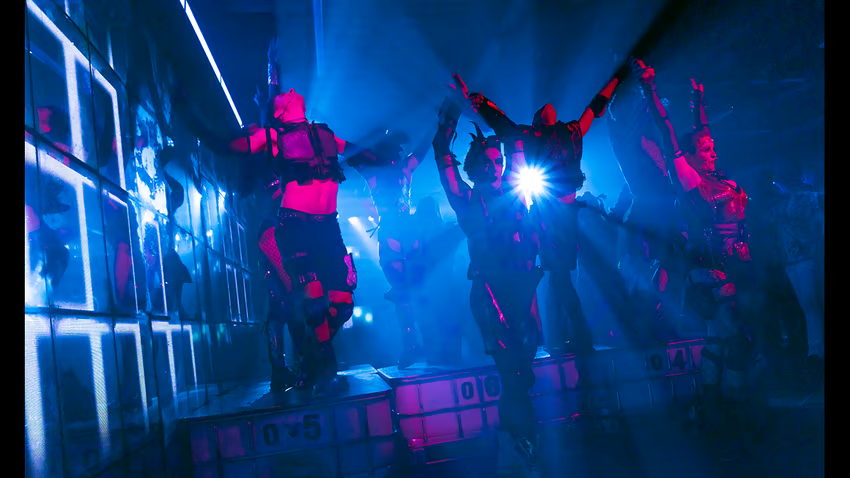
Brompton Technology's Tessera LED video processors are bringing a dystopian future to life in Oscar At The Crown, an innovative theatrical experience running in a converted basement venue beneath London's Tottenham Court Road. The production showcases how advanced LED processing technology can transform intimate spaces into powerful storytelling environments.
Set in a post-apocalyptic world where climate change has torn society apart, Oscar At The Crown follows a group of people exiled for their libertarian views, who have found refuge in a disused underground bunker that once served as a bar. To maintain their sanity and spirits, they perform a nightly musical celebration of Oscar Wilde, reimagined for the modern era with rock music and unbridled expression.
The production utilizes a Brompton 4K Tessera SX40 LED video processor paired with a Tessera XD 10G data distribution unit and redundancy system, all supplied and supported by Stage Sound Services. The centerpiece is a 10m by 2m INFiLED AR series 2.97mm pixel pitch LED wall, concealed behind a two-way mirror that dramatically reveals itself during key moments of the show.
The narrative weaves together themes of free expression and survival, with an unexpected focus on Julie Cooper from The OC, who the characters believe predicted humanity's downfall through social media, noting that Twitter and The OC launched on the same day. This storyline culminates in a nine-minute musical number that transforms the concealed LED wall into what Video and Projection Designer, and Creative Director at video design company PixelLux, Nina Dunn, describes as "a ballistic stained-glass window."
The venue itself, a former storage basement, was transformed into multiple performance spaces including a half tube carriage, banks of TV screens, a bar, stage, and DJ booth, with the LED wall running along one entire wall, which serves dual purposes. It provides set extensions that transport audiences into spaces beyond the physical venue, and creates a massive canvas for the characters' imagination. Content includes Unreal Engine-generated environments that mirror the physical space, alongside live camera feeds from three PTZ cameras capturing the performers.
The production demands exceptional color accuracy and intensity, particularly challenging given the two-way mirror placement and the show's theme of media overload with rapid-fire visual cuts.
"Color is really important to me, along with the intensity of the image," notes Dunn. "I always ride the processor really, really high, and then dim down the content so that if we do need that pinprick sparkle, we can really get it."
The SX40’s interface proved crucial for quick adjustments during the intense production schedule. "How the interface works is really intuitive. I found that very useful, as was just being able to drag color to where it was required. It seemed to be that my requests were met really quickly," Dunn explains.
The two-way mirror presented specific technical challenges, adding a brown tint and dimming the display. Dunn and the PixelLux team, who worked on both the content and engineering of the show, used Tessera's Overdrive function to push through these optical barriers while maintaining color fidelity. "We found the Overdrive button and hit it to make it push through,” adds Dunn. “Having something that's reliable that we can hand over to an in-house team who know how to troubleshoot it was really important."
Oscar At The Crown pushes the boundaries of theatrical experience, combining a club atmosphere with narrative storytelling. The LED screen displays live camera feeds so audience members at the bar can watch the performance, graphics for post-show DJ sets, and animated content synchronized to performers' voguing movements.
"Information in this show is delivered thick and fast,” says Dunn. “One of the roles of video was to try and support the speed of information delivery, because the whole show is about media overload." The SX40 handles this rapid delivery of content while maintaining consistent visual quality across multiple input sources and output formats.
The production concludes each evening by transforming from theatrical performance into an actual club night, with the LED technology seamlessly transitioning from narrative support to dance floor enhancement.
"What was also amazing, just as a workflow thing, is being able to send content upstream and knowing that it will reach the processor reliably. The signal path felt really true to what we were outputting. That was crucial, especially when you're trying to match costume and lighting states,” concludes Dunn. "The show is unique because it's a club night, but it's also a club night with heart because there's a story. Brompton’s LED processing makes this blend of theatre and club environment possible, maintaining consistent visual quality from intense performance moments to post-show DJ visuals.”
Photo Credit: Nina Dunn
.avif)

Support USITT
For many 501(c)3 nonprofit organizations, USITT included, donations are a lifeline. We are able to continue to expand our online offerings to our Members and to our industry thanks to Membership dollars and the generosity of our donors.