
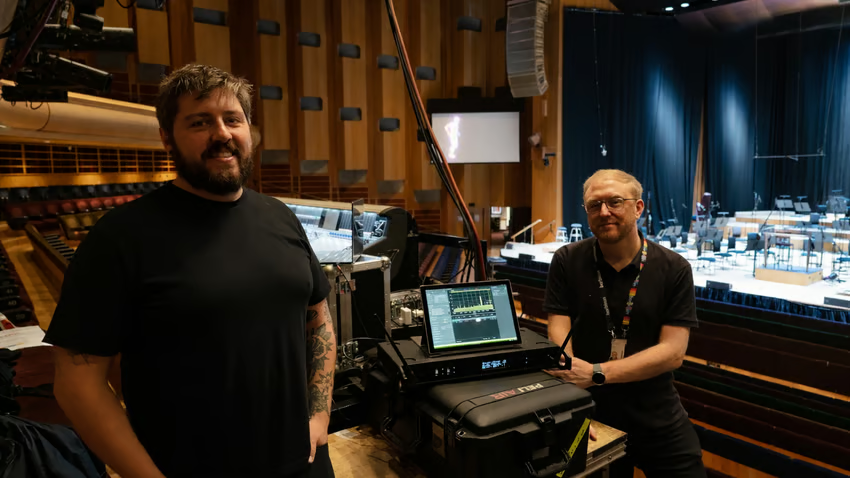
LONDON ― The Barbican Concert Hall hosts a wide range of performances, from classical music and jazz to spoken word and contemporary electronic projects. With nearly 2,000 seats and a highly transparent acoustic environment, it is a venue where technical decisions and consistency matter. It was in this setting that a collaboration between Soweto Kinch and the London Symphony Orchestra(LSO) took place with both a live concert and a live album recording.
This ambitious performance was supported by Freelance Sound Engineer Jack Jordan. “The task was to balance the detailed requirements of an orchestral recording with the immediacy and impact of a contemporary, hybrid live production,” he explains. “The solution came not from reinventing the signal chain, but from refining it, which we were able to accomplish with DPA Microphones’ new N-Series Digital Wireless System accompanied by a DPA d:facto 4018 Handheld Microphone. This allowed us to extend the familiar DPA sound all the way through wireless transmission.”
This project marked the first time that the Barbican team had deployed the DPA N-Series on stage, and the timing could not have been more appropriate. The Barbican has long relied on a substantial inventory of DPA mics, a dependability that Barbican Centre Technical Supervisor David Robinson-Strange values deeply.
“When you work with a consistent manufacturer, you always know what you’re going to get,” he says. “There are no surprises, and that familiarity makes a big difference when you’re managing complex mixes. The Soweto/LSO performance placed vocals, saxophone, rhythm and a full string ensemble in close proximity,” continues Jordan. “Spill control, gain stability and noise floor were critical, especially with microphones positioned close to the PA and an album recording running in parallel.”
The DPA N-Series also allowed Jordan to adjust his workflow. “Normally, the wireless rack lives behind me, so monitoring or making adjustments means using extra screens or cabling,” he explains. “Instead, I was able to keep N-Series right at my workstation, which was immediately useful. But the real benefit revealed itself in the sound.”
With N-Series, users are afforded that clean DPA sound from end-to-end, which offers a subtle but unmistakable difference. “There was simply less noise floor,” continues Jordan. “You don’t notice noise floor disappearing, but you absolutely realize when it’s not there. For a performance that’s being recorded, that silence matters. Handling noise was also minimal, even under the scrutiny of a live recording, and thoughtful features, like silent battery changes, really reinforced that the system was designed by people who understand live performance realities.”
Initially wary of plosives, handling noise and technique, the accompaniment of the DPA d:facto meant that Jordan could deliver a pristine package for the recording team. “There were no faults; it was clean, controlled and protected the vocal even with strings and band close by,” he says. “It’s not different for the sake of being different,” Robinson-Strange adds. “Everything makes sense.”
Beyond vocals, the show leaned heavily into DPA microphones across the orchestra and rhythm section, which the duo estimates was a 98-percent DPA live setup. Strings, percussion, brass and even unconventional placements benefited from a unified sonic character.
“That coherence really matters, especially across strings,” Jordan says. “Keeping the same microphone family gives you a single, intelligible soundstage instead of a collage of tones. The result was clarity without sterility and detail without distraction.”
Both Jordan and Robinson-Strange also remarked on the physical design of the N-Series transmitters, describing them as “reassuringly solid,” according to Robinson-Strange. “In an industry where microphones endure constant handling, costume changes and transport, build quality is an operational requirement.”
For the Barbican, the experience reaffirmed a broader philosophy: technology should support artistry without drawing attention to itself.
More News




Support USITT
For many 501(c)3 nonprofit organizations, USITT included, donations are a lifeline. We are able to continue to expand our online offerings to our Members and to our industry thanks to Membership dollars and the generosity of our donors.