
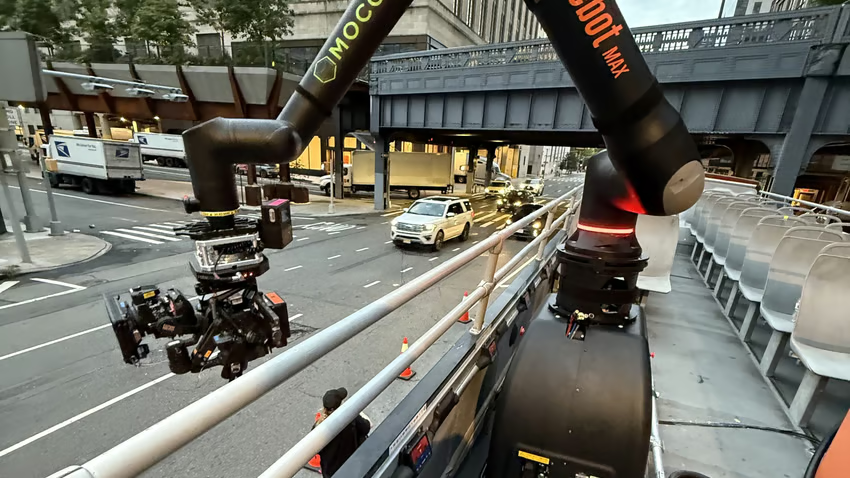
When ‘Adolescence’ director Philip Barantini set out to create a one-hour continuous-shot special following Ed Sheeran across New York City, one of the most technically demanding moments involved capturing a complex sequence atop a moving double-decker bus. With no camera operator legally allowed on the roof and the take unable to be interrupted, Mocolab was brought in to solve an almost impossible problem.
PROJECT OVERVIEW
‘ONE SHOT WITH ED SHEERAN: A MUSICAL EXPERIENCE’ is a bold new undertaking from director Philip Barantini, whose work on the hit UK Netflix series ‘Adolescence’ redefined what continuous-shot storytelling could achieve. Known for crafting long, unbroken sequences in which the camera is passed from operator to operator without a single cut, Barantini brought that same high-pressure, high-precision approach to this one-hour special -- following Ed Sheeran across New York City.
The project demanded that every moment unfold in one continuous flow. The camera would move through streets, venues, and moving vehicles in real time, with no opportunity to reset and no margin for error. Among the most technically complex sections was a scene that needed to capture Sheeran on top of a moving double-decker bus. Standing on a moving vehicle is illegal in New York, ruling out any traditional crane, dolly, or operator-led solution.
This was the moment Mocolab was brought in, tasked with finding a motion control system capable of seamlessly integrating into a live continuous take. The camera would need to be handed onto the robot, carried through a long and intricate move on the bus roof, and handed back off again without breaking the single uninterrupted shot. The question was simple but daunting: what motion control system would be up to the task?
“With a continuous shot, there’s absolutely no hiding. If something goes wrong ten minutes in, you’re starting again from the top. Doing that on a moving bus in New York, with obstacles coming at you and no direct line of sight to the robot, was a level of pressure I had never experienced before. But when it worked, it was magic.”
Josh Treadaway — Motion Control Operator, Freelance
THE CHALLENGE
The difficulties were apparent and complex. How were the team supposed to capture Ed Sheeran on top of this bus with no cuts, no visual effects, and no margin for error, when a camera operator could not legally be up there? It was clear that an unmanned system was required, something that could take the camera smoothly, hold it with absolute stability, and allow the team to mount and dismount it without interrupting the continuous take.
Several options were explored first, including the Bolt™ Jr Plus, which would usually be more than capable under the right conditions, but the specific constraints of a moving vehicle in New York traffic, the need for grounding, trying to run power through a generator, and the limited space for support equipment meant the usual approaches were not viable here.
The production needed a battery-powered system that was compact enough to fit on the bus, light enough to move around, but still strong and versatile enough to deliver an engaging move across more than ten minutes of screen time. Mocolab’s Cinebot Max became the clear choice.
However, this was not all sunshine and roses. The unscripted feel and 360-degree nature of the bus roof meant freelance operator Josh Treadaway, operating the Cinebot Max, could not practically be on top. His motion control tech and Mocolab owner Mike Greenberg needed to be on a headset at rig level while Josh operated blind, while Lee Brown, the camera operator who had worked on Adolescence, gave creative direction.
The bus section itself, as part of the one-hour continuous take, had intense timing constraints. The eleven-minute route through that part of the city needed to match the surrounding live handoffs and was reprogrammed four times as the song order and performance timing changed. Despite the careful previs work done prior to the job, first-day plans were largely overtaken by last-minute adjustments to camera position, blockings, and Ed’s performance.
The urban environment compounded the challenge. Routes through Manhattan are unpredictable; traffic delays, potholes, emergency road repairs, and low clearance bridges all threatened the take. One bridge on 38th Street had only four inches of clearance between the bus roof and the bridge soffit. Josh and Mike rode the route together several times, noting the height of bridges, overhanging tree branches, and stoplights, plotting a safe path and timing each clearance.
Some positions required the arm to be almost fully outstretched while carrying roughly a 13-kilogram payload, and on a bumpy road, that was a real concern. Test runs had wildly different durations: an eleven-minute plan stretched to twenty-six minutes on a test, and a dry run with Ed took forty-five minutes before the NYPD film unit was able to clear a path for the hero runs.
“It was the first time we had mounted the Cinebot Max to a vehicle, let alone on top of a moving bus in stop-and-go traffic. Ultimately, I was nothing short of shocked at the flawless performance of the rig in a bumpy, rough environment. I would be lying to say I was confident before we tried it, but it handled it like a champ.”
Mike Greenberg — Owner, Mocolab
The Solution
Although this sequence of the shot was more than complicated, the Cinebot Max and Josh’s skilled operating proved to be more than enough to get it done. The Cinebot Max offered the reach, the stability, and crucially, the battery-powered autonomy the shoot needed. Running from EcoFlow batteries removed the need for a generator and avoided grounding issues on a moving vehicle. Each day, the team used roughly half a large EcoFlow and found the power solution very reliable.
Mounting the rig was one of the shoot’s technical triumphs. There was no room for standard outriggers on the bus, but luck and good grip craft aligned; the seating bolts matched the speed rail layout almost exactly. The crew removed seats, used the Cinebot Max’s lightweight and narrow rail, and bolted the Cinebot Max directly to the bus floor, cutting a planned day of rigging down to around forty minutes. Two 1.8m pieces and one 1.2m piece of track were fitted, measuring 4.8m in total, and every bit of that track was used during the move.
Camera integration required bespoke solutions. The DP Nyk Allen sourced a custom Mitchell mount plate from California with risers and an electromagnet so the DJI Ronin 4D could be mounted and released cleanly. The camera handoff was precise: the crew positioned and locked the camera into the magnetic Mitchell plate, the key grip released it for the robot to take, and after the programmed move, the camera was handed back for the live on-roof handoff, preserving the continuous take. Josh then operated the robot while Mike programmed the keyframes and Lee provided on-roof creative direction and quick tweaks.
Flair and its unique software features were also mission-critical. Josh used stop points in Flair to pause on keyframes and hold safe heights under the 38th Street bridge, timing each resume to Ed’s performance. He described a technique of holding the mouse down and releasing at the exact beat to get timing right, while for the last two hero runs, he switched to browse mode and manually adjusted speed and timing, effectively turning the Cinebot Max into a flexible crane that could respond to the performer in real time. For the dismount, after the DP and key grip released the magnetic mount, Josh flipped the system into PushMoco mode, and Mike physically pulled the rig along the track to create blocking space, a simple hybrid move that proved elegant and efficient.
Throughout, the Cinebot Max showed a level of rigidity and control that surpassed expectations. It remained stable over potholes, road repairs, and general street roughness. Even in moments where the arm was operating near full extension with a 13-kilogram payload, it held its position cleanly and without compromise. The team had approached the first full run with understandable caution, given the length of the move and the stop-and-go conditions, but the system proved itself almost immediately. What began as a highly experimental approach quickly demonstrated that the Cinebot Max was not only capable of surviving this environment but thriving in it.
The sequence delivered the emotional and cinematic payoff the team was after. Lensing choices, including a four-millimeter glass, allowed Josh to capture heroic low angles, intimate fretboard close-ups, and expansive, swooping moves that felt magical while remaining perfectly matched to Ed’s performance and the surrounding continuous takes. Real passengers were left genuinely surprised and captured authentic reactions that lent the scene a lived-in quality. The interplay of motion control previs, live programming, and browse mode operating produced a sequence that not only hit the marks of the brief delivering the continuous shot but also went beyond to make the scene more immersive and cinematic than imagined.
For Mocolab, the shoot reinforced the value of having the Cinebot Max available on the US East Coast as a dependable, hireable tool for filmmakers who need precision robotics in genuinely challenging live environments. For director Philip Barantini and camera operator Lee Brown, they saw a new piece of go-to equipment for their next ambitious project.
“If you asked me which robot I would invest in right now, it would be the Cinebot Max. This shoot pushed it harder than almost anything I have operated, and it handled a one-take sequence on a moving bus with absolute composure. It is an incredibly capable piece of kit.”
Josh Treadaway — Motion Control Operator, Freelance
Behind the Scenes:
https://www.youtube.com/watch?v=J49t-rLedKo
More News


Support USITT
For many 501(c)3 nonprofit organizations, USITT included, donations are a lifeline. We are able to continue to expand our online offerings to our Members and to our industry thanks to Membership dollars and the generosity of our donors.