
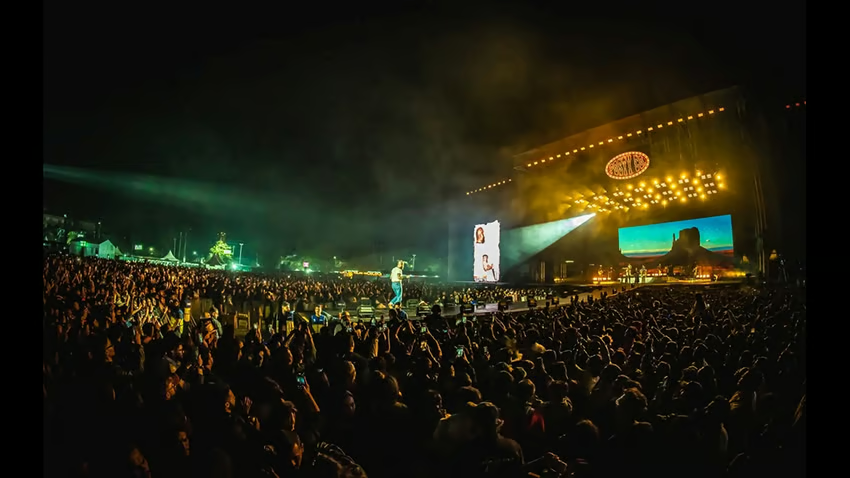
“Events like this are milestones — not just for artists and promoters, but for the entire live production ecosystem in India. Being part of a moment that genuinely moves the needle for the industry is incredibly rewarding,” says Animesh Mishra, Founder Director of Phoenix Networks Global, as he reflects on Post Malone’s landmark Guwahati concert — a defining moment that underscored just how far India’s live entertainment market has evolved, both culturally and technically.
Post Malone’s performance at the Kanapara Veterinary Grounds on 8 December 2025, was everything audiences had hoped for and more. The evening marked the global superstar’s first-ever solo headline concert in the country, and for the tens of thousands of fans who gathered under the winter sky, the concert was a euphoric collision of sound, emotion and connection. Seamlessly blending rap, rock and pop, the artist moved effortlessly between hard-hitting anthems and introspective, melodic tracks, demonstrating the musical evolution that has defined his career. The atmosphere was charged with a sense of shared celebration, and the connection between artist and audience felt deeply personal. Fans described the night as unforgettable — not just because of the music, but because of how completely immersed they felt in the experience.
Industry observers were quick to recognise the wider significance of the Guwahati concert. The event underscored the country’s growing importance on the global touring map; with live events CBOs pointing to the sheer scale of the turnout and the sophistication of the production as clear indicators that India is no longer a secondary destination for international artists, but a market capable of delivering world-class live experiences at the highest level.
Yet, while the spotlight naturally fell on the artist, the true backbone of the evening’s success lay in the precision and depth of the technical production — a factor that, though understated, proved decisive.
To deliver that level of technical excellence, the organisers turned to Phoenix Networks Global, one of India’s most respected rental and comprehensive technical service providers. Tasked with spearheading the complete audio production design and commissioning for the concert, Phoenix Networks Global carried the responsibility of ensuring that every beat, every vocal nuance and every emotional inflection reached the audience with clarity, power and consistency.
Animesh explains that the team’s approach was rooted in both science and sensitivity to the artistic vision, as he informs “From day one, our objective was not just to make the concert loud. It was about making it emotionally accurate. Post Malone’s music moves between genres and moods very fluidly, and our sound system had to be capable of translating every nuance with absolute fidelity across the entire audience area. Shows of this scale are never about one individual or one piece of equipment; they are about people coming together with absolute clarity of purpose. I am immensely proud of our team for the dedication, discipline and attention to detail they demonstrated throughout this project. From the earliest site surveys to the final system tuning on show day, every engineer and technician worked with a shared mindset — to make the audio experience seamless, powerful and emotionally accurate for every single person in the audience.”
Working in line with this vision, what team Phoenix eventually delivered was not merely sound reinforcement, but a fully immersive sonic environment that allowed the crowd to feel genuinely connected to the performance, regardless of where they stood within the massive venue.
From the outset, the challenge was formidable. The sprawling open-air footprint of the concert grounds – with an audience area stretching over 165 metres in length and nearly 120 metres in width – demanded far more than raw power to achieve seamless and uniform audio coverage. This meant that meeting the scale required surgical precision, intelligent system design, and a deep understanding of how sound behaves in large outdoor environments subject to shifting weather conditions.
So, after conducting a comprehensive survey of the venue landscape, and taking into account its physical dynamics, anticipated crowd density, environmental variables and the creative expectations of the concert curators, Team Phoenix engineered a meticulously crafted audio architecture built entirely around Meyer Sound loudspeaker systems, with the PANTHER line arrays sitting at the heart of it all. The decision to do so was both strategic and symbolic, as Phoenix Networks Global currently holds the largest inventory of Meyer Sound PANTHER and LEOPARD line array systems in India, making this landmark concert the ideal platform to deploy that capability at scale without compromise.
Providing an overview of the system, Animesh reveals, “We were working across a very large footprint, and I’d say the real achievement for us was the fact that we optimised all of the individual loudspeaker systems to behave as a single high-quality high-impact sound field. That level of integration only happens when a team truly understands both the science of sound and the emotion of live music.”
Team Phoenix engineered a formidable main PA that formed the backbone of the concert’s sonic impact, deploying a total of thirty-six Meyer Sound PANTHER cabinets deployed as symmetric stereo front-of-house hangs flanking the performance stage. This was complemented by twenty-four additional PANTHER modules flown as two out-fill reinforcement arrays of twelve cabinets each, suspended on either side of the main PA to extend coverage across the width of the venue. All four arrays were precisely angled and perfectly time-aligned to optimise throw, coverage and linearity within the main audience coverage zone; allowing the PANTHER system’s exceptional headroom and sonic transparency to handle the full dynamic range of Post Malone’s performance with remarkable ease. The result was a powerful yet refined sound field that delivered punch without harshness and clarity without listener fatigue, enveloping the audience in a coherent sonic image that preserved tonal balance and vocal intelligibility throughout.
Low-frequency reinforcement with equal intent and precision, as team Phoenix adopted a dual-layered subwoofer strategy that was thoughtfully designed to deliver both physical impact and controlled musicality. The first layer comprised a flown LF array system of twenty-four Meyer Sound LFC-1100 subwoofers deployed as stereo hangs adjacent to the main PA arrays configured in a cardioid pattern and meticulously time-aligned with the PANTHER modules to provide a full-bodied low-end extension with excellent directional control. And perfectly complementing this was an imposing lineup of subwoofers positioned on the ground directly in front of the stage.
Twenty-four additional LFC-1100 subwoofers were arranged centrally in six clusters of four cabinets each, while six Meyer Sound LFC-2100 subwoofers were deployed in two symmetrical clusters placed on either side of the LFC-1100 stacks. This carefully considered configuration delivered chest-thumping depth and authority, creating a low-frequency response that was both visceral and articulate – perfectly matched to the genre-blending intensity and dynamic shifts of Post Malone’s set.
For audience members positioned closest to the stage, front-fill reinforcement played a vital role in maintaining tonal coherence and vocal clarity. Phoenix deployed sixteen Meyer Sound LEOPARD line array modules distributed across the ground-stacked LFC-1100 subwoofers, complemented by four Meyer Sound PANTHER Wide cabinets mounted atop the LFC-2100 stacks. Together, these elements ensured a smooth and natural sonic transition from the stage edge into the broader audience field, effectively eliminating issues such as tonal shadowing or excessive low-frequency buildup at the barricade.
On the other hand, given the exceptional depth of the venue, delay reinforcement proved to be a critical component in preserving clarity and musical timing for audience members at the furthest reaches of the grounds. And so, team Phoenix addressed this by erecting two delay towers, each equipped with eight Meyer Sound PANTHER modules, resulting in a total of sixteen cabinets. Precisely time-aligned with the main system, these delay arrays ensured that even listeners positioned at the extreme ends of the venue experienced the same impactful, coherent and musically engaging sound as those within the main coverage zone.
Highlighting the importance of precision in execution, Animesh noted, “I was particularly impressed by how meticulously our team approached system alignment. When you’re deploying main PA hangs, out-fill arrays, front-fill systems and long-throw delays across a venue of this size, milliseconds matter. The care taken in time-aligning every element, verifying phase coherence and maintaining tonal consistency across the entire audience area is what allowed the sound to feel natural and connected, no matter where you stood,” he says.
Beyond the main audience areas, Phoenix Networks Global also extended its sonic expertise to auxiliary zones critical to the overall event experience. The artist recreation area was equipped with Meyer Sound X80 loudspeakers paired with LFC-2100 subwoofers, delivering high-quality audio suitable for both playback and relaxation. Meanwhile, the exclusive VIP dining area, which hosted dignitaries and officials, featured Meyer Sound X40 loudspeakers complemented by LFC-900 subwoofers, providing refined, controlled sound that matched the premium ambience of the space.
System processing and networking formed the invisible backbone that tied this vast audio ecosystem together. The entire loudspeaker system was managed through six units of the Meyer Sound GALAXY 816 processor, providing advanced system optimisation, alignment and control. Audio networking implemented the MILAN protocol, ensuring deterministic, low-latency signal transport across the system. In tow, Luminex GigaCore 30i switches were employed to facilitate closed communication between front-of-house and monitor positions, enhancing reliability and operational stability throughout the event. This robust processing and networking foundation also ensured that the transition from system architecture to live show control was seamless, allowing multiple console environments and operational workflows to integrate effortlessly into a single, unified production ecosystem.
While Post Malone’s touring team arrived with their own RF and console package, including DiGiCo Quantum 852 consoles for both front-of-house and monitor mixing, Phoenix Networks Global seamlessly integrated this setup into the broader system architecture. For the opening and supporting acts, Phoenix deployed their own DiGiCo Quantum 338 digital mixing consoles, complete with Optocore interfaces, at both FOH and monitor positions. This ensured a consistent, high-performance mixing environment for every artist on the bill. In tow, performers were supported with world-class Shure Axient Digital wireless systems, alongside extensive deployments of Sennheiser in-ear monitoring systems, providing stable, interference-free operation even in the demanding RF environment of a large outdoor concert. Team Phoenix also supplied a comprehensive backline inventory, meticulously matched to each artist’s technical rider, ensuring smooth transitions and uninterrupted performances throughout the evening.
Reflecting on the scale and complexity of the project, Animesh admits that success was an outcome of disciplined preparation and teamwork, stating, “A concert of this magnitude left no room for guesswork. Every decision — from system design to deployment and tuning — was made with absolute clarity. Our team approached this show with the mindset that every single person in the audience deserved the same emotional experience, whether they were standing at the barricade or at the very back of the grounds. Our engineers trusted the design, trusted the data, and trusted each other. That’s why we were able to merge such a complex sound deployment into a single, cohesive sonic experience that complemented Post Malone’s performance rather than competing with it. I couldn’t be prouder of what our team has achieved with this landmark show. This concert reaffirmed my belief that technical excellence is built on teamwork and trust!”
More News




Support USITT
For many 501(c)3 nonprofit organizations, USITT included, donations are a lifeline. We are able to continue to expand our online offerings to our Members and to our industry thanks to Membership dollars and the generosity of our donors.