
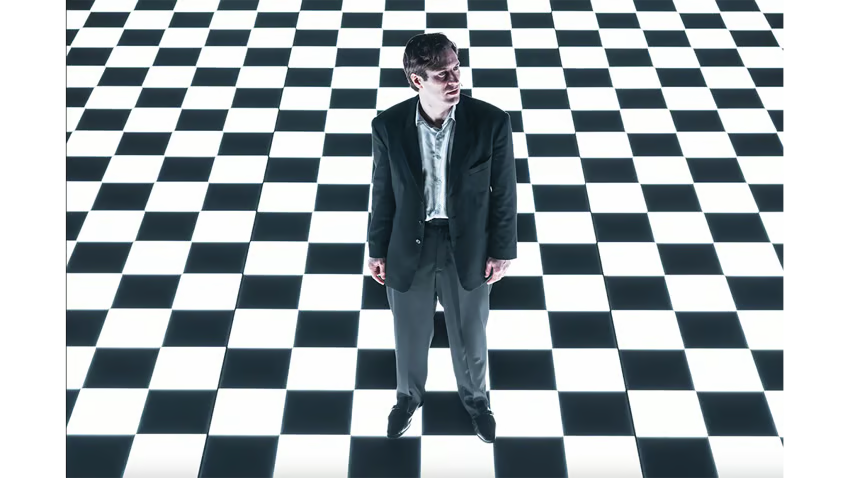
Brompton Technology’s Tessera LED processors are at the heart of the critically acclaimed revival of the American Psycho musical, which ran at London’s Almeida Theatre from January to March this year. Directed by Rupert Goold and based on Bret Easton Ellis’s 1991 cult novel, the production, which originally premiered at the Almeida in 2013 before a Broadway run in 2016, brings razor-sharp satire and high-energy 80s pop aesthetics to life through an LED floor that is central to the show’s visual storytelling.
The system, comprising ROE Black Marble 4 panels powered by Brompton’s Tessera SX40 processors, was supplied and integrated by Universal Pixels. Installation was led by Dom Coppola and Scott James of Universal Pixels, with final configuration by Matt Morris.
The production features set design by Es Devlin and video design by Finn Ross of FRAY Studio, with lighting by Jon Clark. Rather than a conventional upstage LED wall, the creative team opted for a full LED floor, a decision that allowed performers to become light sources themselves, lit from beneath, creating an immersive and psychologically intense visual environment. The floor incorporates a drop, slide, and lift mechanism, enabling set pieces to be pre-loaded and deployed rapidly within the Almeida’s intimate space.
The requirements set by the creative team were stringent. “The design team had a request for an LED floor that was capable of 10-bit color, which was non-negotiable,” says James Paul, Theatre Lead at Universal Pixels. “We were able to utilize our ROE Black Marble 4 on Brompton, which was the perfect product for this. The LED panels needed to be incredibly bright, as they were the only light source in the room at some moments, creating an impressive visual effect. The product also needed to be flush at the edges so the thrust stage looked as clean and sharp as possible, allowing the audience to sit close to the stage.”
Durability was equally critical. The cast’s demanding choreography, combined with the constant movement of scenic pieces across the floor, required a surface that could withstand heavy use without deterioration. The ROE Black Marble 4’s hardwearing matte tile surface proved ideal for the job. The processing setup, two 4K Tessera SX40 LED processors and four XD 10G data distribution units with full processor and cable redundancy, reflected how integral the LED floor was to every aspect of the production.
Having worked on both the original 2013 Almeida production and the 2016 Broadway run, Video Designer Finn Ross was determined that this revival would look entirely different: a complete visual overhaul to reflect both a new political moment and a more stripped-back, performer-led approach to the storytelling.
To this end, the LED floor represented both a creative and technical breakthrough for the show. “Rather than working with the usual upstage LED wall, it was quite satisfying to do away with that and have the actors stand on the LED floor instead,” he explains. “Working with a lighting designer like Jon Clark, who isn’t afraid to use just a few lights or let people actually be the light source, was exciting. You have these moments where people have this incredible glow lifting them from underneath, reinforced by something that can produce a solid, reliable colour that you can key in with lights.”
The intimacy of the Almeida placed particular demands on color precision. With audiences seated close to the stage, the absence of any visual artifacts was vital. “LED walls in theatre are a difficult thing to make work because they like to be bright, but in theatre we don’t like them to be bright,” says Ross. “Having features like PureTone keeps the color range but also allows you to use the wall at a much lower level. Being able to work in 10-bit was really helpful, too. Because the audience is just so close, there’s nowhere to hide when people are close to the pixels, and because we were working in a lot of block colors and gradients, having that color information was invaluable.”
The content itself, displayed on the LED floor, was built around a strict visual language developed by Ross and set designer Es Devlin; a system combining block text, gradients, and analogue noise interference. Noise textures were locked tightly to the music using drum stems from the show’s electronic dance score, with frames advancing on the beat. Luma mattes shaped the stage around performers, and at key dramatic moments a white noise blood splatter erupts beneath a character. Art-Net control over the Brompton processors allowed smooth, dynamic level changes throughout, with the production ultimately driving the floor to full brightness for the show’s climax, a first for Ross in a theatre environment.
For Universal Pixels, Brompton’s reliability and support made it the natural choice for a production where failure was not an option. “Reliability and fast support is critical when working on theatre productions,” says Paul. “For shows like this where the screen is integral to the storytelling, we have nowhere to hide. With long gradients spanning the entire length of the screen, we were able to avoid banding due to 10-bit color and utilizing features like Dark Magic and Extended Bit Depth to give us perfectly smooth gradients.”
Ross credits Brompton’s understanding of the theatrical market as key to the system’s success. “Brompton always wins for me because the company understands our end of the market and what we’re trying to do,” he says. “Especially when you pair it with a quality tile, I feel like I can confidently say I can make LED work in a small, sensitive space. With Brompton, you know you’re not going to have to compromise an idea, because you know it’s going to do a great job.”
"American Psycho is a perfect example of what's possible when LED technology is pushed beyond its conventional use in theatre,” concludes Patrick Goodden, Technical Sales Manager (UK and Ireland) at Brompton Technology. “The creative team's decision to put the screen on the floor rather than the wall, and use the full range of brightness in such an intimate space, speaks to a growing confidence in what Tessera processing can deliver. We're proud to be part of productions that treat LED as a genuine storytelling tool."
Photo Credit: FRAY Studio
More News



Support USITT
For many 501(c)3 nonprofit organizations, USITT included, donations are a lifeline. We are able to continue to expand our online offerings to our Members and to our industry thanks to Membership dollars and the generosity of our donors.