
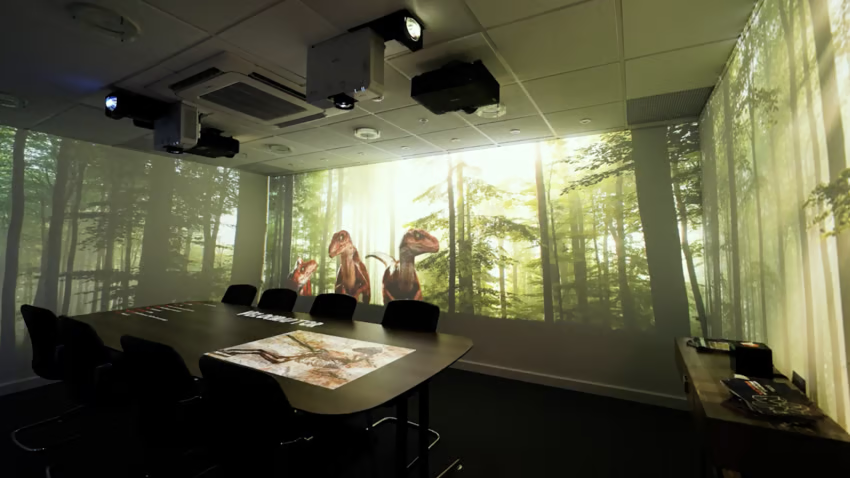
London, UK — Motion Mapping has launched its London Design Centre Experience — a purpose-built immersive environment showcasing advanced media server technology, with Hippotizer Boreal+ MK2 Media Servers at its core.
Designed as a living laboratory rather than a traditional showroom, the Centre invites visitors to step inside fully realized experiential environments where projection mapping and interactive systems transform physical spaces into responsive, data-driven experiences.
Running until the end of April, it functions as a working prototype of contemporary spatial design, where projection, LED, sensors, “magic” glass, physical materials, and interactive systems are orchestrated through a unified media server workflow.
For Motion Mapping, the London Design Centre installation was conceived in response to a recurring challenge faced by brands, agencies, and AV professionals: the difficulty of communicating immersive concepts through conventional formats such as videos, renders, presentations, and flat surfaces.
“As good as videos are, you don’t get the experience when you’re watching it on a screen,” says Stuart Harris. “We wanted a place where people could come in, experience immersive environments directly, and understand what’s technically and creatively possible.”
Rather than presenting isolated demos, the Centre integrates multiple technologies into cohesive spatial narratives. Visitors encounter projection-mapped surfaces, mixed-media environments, interactive installations, and responsive architectural elements, each designed to show how immersive technology can operate at scale across commercial, retail, cultural, and entertainment contexts.
“We don’t sell what we do, we let people experience it,” Harris explains. “Once people experience immersive technology in a physical space, their understanding changes immediately.”
While LED remains a dominant format in many AV installations, Motion Mapping has deliberately positioned projection as a central design tool within the Centre. The installation demonstrates how projection can extend beyond flat surfaces to interact with architectural features, glass, objects, and layered materials.
“There’s still a perception that projection has to be flat and in a dark environment,” says Harris. “We’re showing that projection can be used dynamically, in bright spaces, on complex surfaces, and in combination with other media.”
Hybrid environments throughout the Centre combine projection, LED, vinyl graphics, switchable glass, and physical props, illustrating how mixed-media workflows can create depth, theatricality, and spatial continuity.
“LED and projection don’t have to be separate,” adds Harris. “When you integrate them, you move from displaying content to designing environments.”
The immersive room’s video infrastructure at the Centre is driven by the Hippotizer Boreal+ MK2, chosen for its real-time playback performance, flexible input/output architecture, and integration capabilities.
“For us, Hippotizer is a natural platform,” says Harris. “We’ve been using it for a long time, so it’s intuitive. Using Hippotizer’s SHAPE feature, we can map a room in 20 to 30 minutes, which fundamentally changes how quickly immersive environments can be designed and deployed.”
The Boreal+ MK2 Media Server acts as the backbone of the immersive area’s content pipeline, managing multi-surface projection mapping, real-time playback across multiple outputs, integration with interactive systems and sensors, synchronization of mixed media formats, and rapid reconfiguration for different experiential scenarios.
By leveraging Hippotizer’s real-time mapping and control capabilities, Motion Mapping has created a workflow where spatial content can be iterated, scaled, and repurposed with minimal technical overhead.
“What used to feel like a science project is now something we can deploy reliably,” Harris says. “Hippotizer allows us to connect triggers, cues, and interactions seamlessly, so environments respond instantly to user behavior.”
The Centre showcases a range of interactive technologies integrated into the media server workflow. These include QR-based web interactions, RFID triggers, electromagnetic sensors, and responsive surfaces, with real-world brands and products to play with.
Rather than treating interaction as an add-on, Motion Mapping uses Hippotizer as a central layer, connecting physical inputs to visual outputs in real time. “Interactive states across the space feed data into a central dashboard,” Harris explains. “That data can be viewed remotely and integrated with other systems, such as POS or analytics platforms.”
This approach demonstrates how immersive environments can function not only as creative experiences but also as measurable, data-driven platforms - an increasingly important consideration for brands and agencies.
Motion Mapping’s installation also highlights applications of immersive technology across retail, brand experience, and entertainment. One example is Motion Mapping’s immersive retail installation for IKEA; another is an automatically triggered video for Doritos to make its hot-taste products palpable. These live demonstrations bridge the gap between conceptual design and practical implementation.
“When the whole room becomes a canvas, anything is possible,” Harris adds. “People don’t just imagine immersive environments, they experience them. And once they’ve experienced them, their expectations of space, media, and storytelling change. With the right media server architecture, interaction systems, and creative strategy, they are scalable, measurable, and commercially viable.”
Photo Credit: © Motion Mapping
More News

.avif)

Support USITT
For many 501(c)3 nonprofit organizations, USITT included, donations are a lifeline. We are able to continue to expand our online offerings to our Members and to our industry thanks to Membership dollars and the generosity of our donors.