
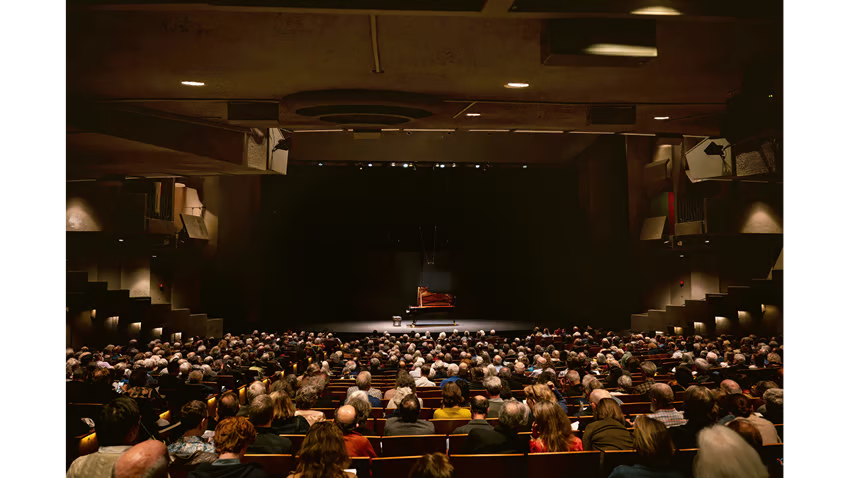
Zellerbach Hall at the University of California, Berkeley—home to Cal Performances, one of the nation’s leading university-based arts presenters—has entered a new era of acoustic flexibility with a next-generation Meyer Sound Constellation® acoustic system. The upgraded system expands the venue’s pioneering 2006 installation of the first Constellation system with broader coverage, finer control, and an improved stage tuning that helps performers hear and communicate better than ever before.
The system was designed by Meyer Sound’s project team; voiced by John Pellowe, Meyer Sound’s project director, Constellation systems and Pierre Germain, Constellation Director and installed by San Francisco-based AV integrator BugID.
With its sweeping balconies, deep overhangs, and concrete massing, Zellerbach Hall embodies the bold functionalism of its era. Those same architectural features have defined the acoustic experience for generations of artists. The renewed Constellation system is designed to work within that architecture, providing the precision and adaptability needed to support a wide range of performances.
Built around Meyer Sound’s NADIA™ integrated digital audio platform, the upgraded system incorporates 110 UP-4slim™ ultracompact installation loudspeakers, 22 ULTRA-X20™ and 16 ULTRA-X20XP™ compact point source loudspeakers, 12 Ashby-8C™ and 12 Ashby-5C™ ceiling loudspeakers, powered by two NADIA-CP™ core processors and 14 NADIA-AO16™ 16-channel processors.
Germain, who led the system design, notes the impact of the new system architecture and processing advances: “Instead of one VRAS processor for early reflections on stage, there are now four of them, allowing us to split the stage into quadrants. This expansion allows more nuanced shaping of the onstage acoustic field, where musicians depend on early-reflection cues to hear across ensemble sections.” The NADIA platform also gives Zellerbach new sound-design flexibility with support for Meyer Sound’s Spacemap® Go spatial sound design and mixing tool.
As the installation progressed, the physical complexity of the project became clear, says BugID owner Matt Lavine. “Zellerbach is a challenging building—concrete everywhere, tight timelines, and multiple agencies involved—but the collaboration with Meyer Sound made precision possible where it mattered most.” That precision carried through every stage, he adds: “Constellation installs require a bit of back and forth. Precision is key; the relationship of the speakers to the microphones is so critical.” Visual integration was equally important: “Everything was custom painted, even the cable pathways.”
Ahead of fall performances, Pellowe worked with London’s Philharmonia Orchestra to refine onstage balance across Constellation zones. The process, he says, underscored how profoundly the system has evolved: “It’s now a very different story. We’ve added lots of loudspeakers and equipment that wasn’t there before, and we’ve got new algorithms and many more zones.”
Those early rehearsals were part of a larger fall program that included symphonic performances, piano recitals, dance programming, and amplified productions. Constellation enables smooth transitions across this broad range of acoustic demands, supporting what Pellowe describes as “a room that behaves like a flexible instrument while preserving its character.”
“Zellerbach is a hall where innovation meets artistry, and this new Constellation system makes us a more articulate musical partner for our visiting performers,” says Cal Performances Executive and Artistic Director Jeremy Geffen. “What audiences hear is a more focused, more connected performance; what musicians feel is a room that supports them while staying true to its identity.”
Critical reaction has highlighted the clarity and naturalism of the upgraded system. As Richard S. Ginell wrote in Classical Voice North America (Oct. 21, 2025): “As has been true with every application of Meyer Sound digital systems I have heard, it was almost impossible to tell without knowing in advance whether we were hearing natural sound or digitally enhanced sound.”
“Cal Performances has been part of Meyer Sound’s story for decades, and Zellerbach Hall has always been a place where our ideas could grow alongside extraordinary artists,” says Meyer Sound Executive Vice President Helen Meyer. “It feels especially meaningful to celebrate nearly twenty years of Constellation here—where the technology began—by giving this hall new definition, flexibility, and life for the next generation of performances.”
About Meyer Sound
Founded in 1979 by John and Helen Meyer, Meyer Sound is the global leader and innovator in self-powered loudspeaker systems, active acoustics, spatial sound mixing, and sound system design and prediction tools. Headquartered in Berkeley, California, with operations globally, the company is driven by a singular mission: to create the best sonic experiences in the world. With more than 100 patents and a legacy of breakthrough technologies—including the first dedicated loudspeaker processors and large-scale self-powered arrays—Meyer Sound combines scientific innovation with precision craftsmanship. Its premium systems power the world’s most iconic concert tours and festivals, theatrical productions, cinemas, houses of worship, educational institutions, and more. The company champions sustainable manufacturing and invests in the future of sound through education and global partnerships.


%20with%20GLP%27s%20Udo%20Kunzler.avif)
Support USITT
For many 501(c)3 nonprofit organizations, USITT included, donations are a lifeline. We are able to continue to expand our online offerings to our Members and to our industry thanks to Membership dollars and the generosity of our donors.