
.avif)
When THE Sixth Sense Festival was imagined as a living, breathing nucleus of immersive discovery, it demanded more than creative ambition; it required technological finesse and expertise of a true industry leader. It needed the magical touch of Synergy Technologies – one of India’s leading visual technology solutions-provider.
Recognised as India’s first and largest multidisciplinary immersive festival, THE Sixth Sense Festival unfolded across more than 200,000 square feet of industrial architecture in Bengaluru, and at the heart of its most visually awe-inspiring experiences stood team Synergy.
Conceived by Swordfish, THE Sixth Sense positioned itself not merely as a festival, but as a non-linear journey through art, technology and nature’s intelligence. Spread across the stone-clad hangars, a towering silo and planted forest of a six-decade-old factory at Alembic City, the event brought together digital installations, spatial sound performances, interactive environments and forward-thinking workshops. It was within this ambitious canvas that Synergy Technologies was commissioned to deliver a superlative and comprehensive projection mapping extravaganza across three flagship zones: the Immersive Room, the Silo and the Live Performance Arena.
For Synergy Technologies’ Founder, Chirag Patel, the partnership was instinctive: “Swordfish are true visionaries. Their ideas were bold, genre-bending and uncompromising in scale. India has not witnessed anything of this magnitude in immersive art before. And for us at Synergy, it was not simply about executing a technical brief; it was about enabling a cultural milestone that could redefine how world-class immersive experiences are perceived, produced and experienced.”
Synergy’s reputation for orchestrating visually enchanting spectacles had already been cemented through landmark projects such as the Mumbai Light Festival and a long-standing association with The Floating Canvas Company; among several other path-breaking projects across the country. Yet Sixth Sense presented a new order of complexity.
To crystallise the festival’s ambitious vision, the planning stage spanned several months, with team Synergy collaborating closely with the organisers from the earliest conceptual stages. However, as the days to the festival approached, team Synergy were afforded just 72 hours to deploy an intricate network of high-performance visual systems across the sprawling campus.
Logistics was the first hurdle. Every piece of equipment had to be transported from Mumbai to Bengaluru, a process that demanded meticulous coordination and contingency planning. Drawing upon foresight earned through years of large-scale production experience, team Synergy carried additional projectors, bespoke lenses, media servers and signal distribution systems to ensure operational resilience.
The venue posed the next challenge. Though rich in character, the venue was laced with formidable environmental challenges. Uneven surfaces complicated installation logistics. Thus, before a single piece of equipment could be moved in, the environment itself had to be rendered workable.
Signal architecture also became a science unto itself. Different artists required distinct signal workflows, broadly divided between HDMI over fibre optic transmission and SDI infrastructure. Hence, team Synergy worked in advance with each management team to understand technical rider specifications, ensuring seamless integration even before the rehearsals commenced.
Certain as day though, was team Synergy’s focus on deploying world-class tech for the festival. Across all three zones, the team standardized on state-of-the-art laser projection technology from Christie Digital Systems, globally respected for reliability and visual fidelity. Yet, as Chirag explains, hardware choice was never arbitrary. “Every space demanded its own philosophy of projection,” he says. “Brightness, pixel density, throw distance, ambient light interference, architectural geometry — each of these factors dictated a different solution. Our job was to balance artistic intention with optical physics.”
In the Immersive Room, a 2,500 square foot enclosure where visually enchanting and vivid projections enveloped walls and floor alike, as team Synergy deploying fourteen units of the DWU2400-JS laser projector from Christie’s Jazz Series, each delivering 23,750 lumens of output to achieve seamless coverage. And to ensure unparalleled reliability, all projectors were securely truss-mounted, ensuring unparalleled stability.
However, spatial constraints did demand for surgical precision. The ceiling height allowed barely twelve feet of clearance from lens to floor for the downward projections. Therefore, four of the projectors were retrofitted with specially imported high-performance ultra-short throw lenses, among the most refined globally for such applications, to facilitate distortion-free floor projection within the tight vertical envelope. The remaining ten units which were utilised to meticulously map the standing walls within the room, were also equipped with specially procured customised lenses selected to preserve uniform brightness, accurate colour grading and perfect pixel ratios across irregular surfaces.
Control of this intricate mapping workflow was entrusted to Dataton media servers running WATCHOUT 7 multi-display production and playback systems – a reliable architecture that orchestrated perfect synchronisation. And supporting the data-intensive environment, Synergy deployed Lightware HDMI20-OPTJ-Tx/Rx90, guaranteeing near-zero latency transmission and absolute signal integrity.
“Within the Immersive Room, clarity, vividness and uniformity were paramount,” Chirag notes. “The Christie Jazz Series gave us exceptional brightness relative to its footprint, which was critical in the confined environment that we had. Our decision to specially import the customised ultra-short throw lenses proved to be a game-changer in this situation, as it allowed us to maintain geometry without compromising resolution and impact. Meanwhile, Lightware’s fibre extenders ensured signal stability over distance without introducing latency. When you’re projecting across every surface, even microseconds matter.”
If the Immersive Room was an exercise in contained precision, the Silo demanded audacious improvisation. The circular façade of the former raw material storage structure presented a curved projection surface, wherein the building was surrounded by dense trees and outcrops. Projection access for the team was limited strictly to the front of the building, as the site’s integrity had to be maintained. Thus, team Synergy once again drew on their years of experience and expertise to come up with an innovative yet methodically and precisely executed solution, wherein the projection happened through narrow gaps between trees, with the team ensuring precise projector placements that were calibrated to millimetric accuracy.
For this rugged outdoor setting, Synergy deployed six units of the Christie D20WU-HS laser projector, each delivering 20,600 lumens with BoldColor technology, alongside a single Christie Griffyn 4K50-RGB pure laser projector producing a formidable 50,000 lumens of native 4K brilliance. Once again, each unit was retrofitted with specially imported high-performance lenses to maintain sharpness, accurate coverage and vivid colour reproduction across the curved façade. The mapping workflow was driven by Resolume Arena media servers, enabling dynamic control over complex architectural surfaces.
“The Silo presented a unique challenge,” Chirag admits. “In addition to all the environment challenges with the projector placement, which team Synergy handled with great finesse; the curvature of the structure meant we had to account for geometric distortion across multiple axes. The Griffyn 4K50-RGB gave us extraordinary colour volume and brightness headroom, essential for outdoor projection against residual ambient light. Combined with the D20WU-HS units, we achieved a layered visual narrative that respected the building’s architecture while transforming it entirely.”
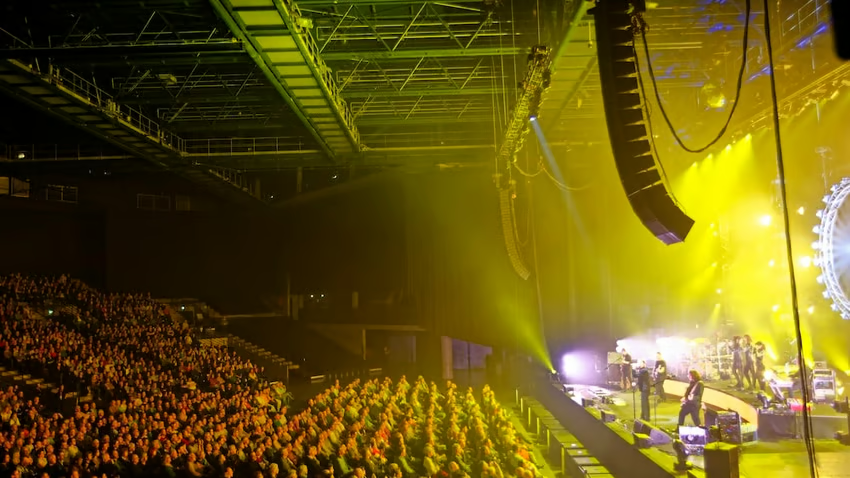
In the Live Performance Arena, projection mapping reached theatrical crescendo. Audiences encountered a panoramic 180-degree visual expanse, where stage backdrop and side walls became a creative canvas, while a transparent mesh screen suspended between performers and audience introduced a two-layer projection design that culminated in holographic visuals elevating performances into immersive storytelling.
Four Christie DWU23-HS laser projectors with BoldColor+ technology, each rated at 23,650 lumens, were deployed to orchestrate this visual architecture; wherein one unit energised the holographic mesh with luminous depth, another illuminated the stage backdrop, while two mapped the lateral walls, creating an enveloping environment that responded dynamically to performances by artists such as Max Cooper, whose 3D/AV live set fused electronic composition with mind-bending visuals.
“Performance environments demand reliability above all,” Chirag explains. “The HS Series projectors provided the robustness and colour integrity required for extended live sets. The holographic mesh element required exact brightness calibration; too little and the illusion fails, too much and the transparency collapses. Precision was everything.”
Beneath the surface of the meticulously calibrated visual architecture at Sixth Sense Festival lay a team whose perseverance and discipline proved just as critical as the technology itself. And Chirag reflects on this, stating, “This festival tested human endurance as much as technical expertise and creativity. Against time, environmental adversity and logistical complexity, team Synergy never allowed standards to slip. Delivering a flawless, uncompromising visual experience under such pressure reflects the discipline, cohesion and culture of excellence we’ve built at Synergy.”
And while the festival in itself presented a truly ‘first of its kind’ experience to the country; the festival’s broader ethos spanned beyond art, creativity and technology – something that resonated deeply with Chirag. Days before the festival opened its gates, the organisers partnered with The NODE Institute to host India’s first TouchDesigner sessions, fostering dialogue between international experts and India’s burgeoning creative coding community.
“We want to be associated with endeavours that build ecosystems, not just events,” Chirag concludes. “If India is to establish itself on the global map for immersive art, we must nurture technical literacy alongside artistic vision. THE Sixth Sense was not just a spectacle; it was a statement that our industry is ready to lead. And we’re always proud to support such visionary initiatives!”
More News

Support USITT
For many 501(c)3 nonprofit organizations, USITT included, donations are a lifeline. We are able to continue to expand our online offerings to our Members and to our industry thanks to Membership dollars and the generosity of our donors.