
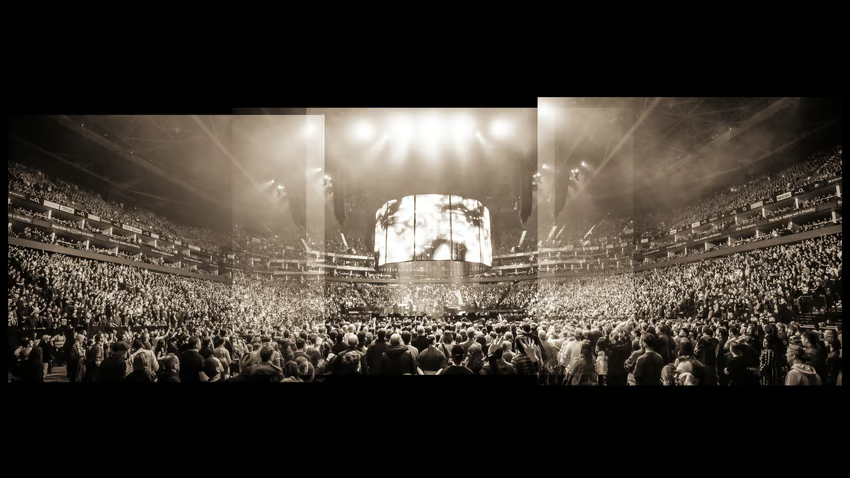
Seven years in the making, Radiohead's return to stage provided fans with an exceptional in the round experience, offering a production design that brought audiences closer to the musicians following the British art rock band's significant rest from touring.
Working with Production Manager John Lafferty and Tour Manager Adrian Bullock, Britannia Row Productions designed and supplied audio, comms, radios, global RF licensing and data services to the tour, including what would become a record-breaking four-night residency at London's O2 Arena.
Simon Hodge, FOH Engineer, has worked with frontman Thom Yorke in various creative endeavors over the years, but this 2025 outing to Europe marked the first with Radiohead.
"This tour is a huge moment for them after such a long break," he begins. "They're making a statement with the style of these shows - doing an in the round tour is bold and creative and the sound design had to match that. We've tried our best to make it sound as intimate as possible despite the large areas we're covering. We've spent a lot of time choosing all of the components involved, on the stage and hanging in the air, and I think it adds up to perfect sonics."
In the round challenges
In the round audio designs can present challenges: "The geometry at the bottom and top of the array can be difficult, where one hang meets another, but Josh Lloyd, System Designer, and Giacomo Gasparini, Systems Engineer, along with using the L-Acoustics L2 system made it quite seamless," explains Simon.
A small stage design and a clever audio rig, which included the flown PA having its amps also flown nearby, creating sonic and practical benefits and a small footprint on the floor, was the start of a complex and integrated system. One of the biggest challenges with an in the round show is firing all sources out at the venue, creating more reflections and potentially getting a sum of all the energy back on stage.
Josh furthers this notion: "With an in the round PA design, it can be difficult to minimize the amount of spill onto the stage. Using the L-Acoustics L2 for its cardioid behaviour we got the rejection needed. We also had the challenge of PA placement in the centre of the arena, where typically, a scoreboard may hang, but the economy of weight of the L2 and the sub array helped the rigging plan to be achievable."
He continues: "We used the TM Array, a design named after the German engineer Thomas Mundorf. This exhibits line array conduct in the vertical, with vertical coverage controlled by the vertical length. The electronic steering of the array exhibits an omni directional pattern in the horizontal. We have a block of subs in the middle of the design, and essentially, when you're at the very bottom of the array, you’ll experience cancellation. However, as you move further away from it onto the arena floor and up to the high seats, you’ll benefit from the summation of the sources.
"Horizontally, they're all very close and sum nicely together, so we get very even coverage for the audience vertically. In the time it takes for the sub to reach someone, the high frequency from the L2 is aligned physically in all locations of the arena due to the equidistance of all L2 boxes to the subs. It's the dream to have a singular sub source, but it also had some benefits for this creative design. The band are situated directly below the cluster, where it creates the cancellation, meaning on stage, there's no pocket of noise."
This results in the tonal balance being consistent across the audience, which with Radiohead being such a musically dynamic band, building up to be loud and then very quiet, it gives consistent SPL in the round.
Josh continues: "When they do perform the quieter songs, the level difference at the very back of the venue is tiny in relation to the floor. We're distributing redundant AVB to amplifier, with an analogue backup into the amps which is run via Madi over fibre and converted to analogue, so we've got a redundant pair of fibres going to each location, and for each quadrant of the PA there's a custom flown amplifier cart which houses all motor control, amplifiers and signal distribution. The sub array also has a custom lifting frame for the tour that conceals all amplifiers and cables, co-designed with and fabricated by the tour’s technical directors, Wonder Works."
The PA can be flown or de-rigged in an hour, truly streamlining this audio build.
A Dante-based control package
During Thom Yorke's solo tour of Japan last year, Simon conceived a compact air freight rig and opted to use a fully Dante based system based around the Rupert Neve Designs RMP-D8. He says: "It's an 8-input mic amp which outputs to Dante. Pairing that with Yamaha Rivage worked well and everyone loved the sound. This year, Daniel [Scheiman, Monitor Engineer] and I decided to try it for Radiohead, and we all agreed that it sounds amazing. We now have 14 RMP-D8s and a PM10 surface at both ends."
He adds: "I have spent a lot of time in front of multitracks with the band, so primarily I'm communicating the sound that they want. They're energetic and their set takes many forms, but I can't stress how important their live sound is to them. While the creative and visual design is extremely important, with Radiohead, audio is their number one priority - a wonderful luxury for us."
"It is a pretty incredible show to mix!" begins Daniel. "From the first day of rehearsals and up until the last song of the last show was performed, there has never been a dull moment. The experience has been extremely engaging; it's an absolute pleasure to work with a band with such interesting music and such a deep and diverse catalogue."
The production's space-saving design also came into play in monitor world, where the desk was placed backstage for the duration of the tour. Daniel mixes from backstage, a location first for him: "It has been a bit different. It's the first time I've ever had to figure out this type of set-up, and not being at the side of the stage. It provided some challenges for sure - not being able to feel the energy of the room and not having a direct line of sight with the band for quick, easier adjustments. Fortunately, we had such a great system of talkbacks and camera feeds, it all helped to keep me clued in."
Daniel also mixed on a Yamaha Rivage PM10 with the DSP-RX. "We went with Yamaha on this for the amazing sonic quality and onboard effects, and the DSP-RX was essential for the channel count we are running."
A combination of Wisycom IEMs and M4 wedges are also utilised. "The Wisycom sounds great, and the bandwidth makes it so versatile," he says.
Outside of inventory, Daniel comments on the vendor service received: "From beginning to end, we were so well supported by Britannia Row. Their team is always so responsive to questions, and Dave Compton, our Account Executive, is always a pleasure to work with."
A converged solution
Britannia Row and its dedicated communications brand, Surfhire, has also designed and supplied comms and data services. Simon elaborates on this part of the delivery: "Brit Row and Surfhire have provided a converged solution that entails audio, wired intercom, wireless intercom, wired internet and WiFi to all working areas in the venues. By converging infrastructure for these services, it's made everyone's lives on tour easier and work pace faster. Being on board during a key stage of planning for audio, data and comms, we have been able to deliver something quite special - more bands should do this!"
Radios and radio channels were again integrated into this plan so that certain radio channels could interface with comms and audio as required.
Simon concludes: "Surfhire secured all RF licensing for the tour, again, converged for all needs across multiple departments for stage RF and comms unique to each venue. This allowed pre-programming of radio and comms zones as well as planning for radio mics and IEM systems."
Helping to create this technically intricate and fan immersing tour, the Britannia Row Productions crew was completed by Assistant System Technician, Cesar Lopez; PA Technicians Joseph Walton & Thomas Robson; RF / PA Technician, Matthew Hayes, Monitor & Stage Technician, Ross Alexander Anderson and Stage Technician, Oli Middleton.
Photo Credit: Alex Lake
More News



Support USITT
For many 501(c)3 nonprofit organizations, USITT included, donations are a lifeline. We are able to continue to expand our online offerings to our Members and to our industry thanks to Membership dollars and the generosity of our donors.