
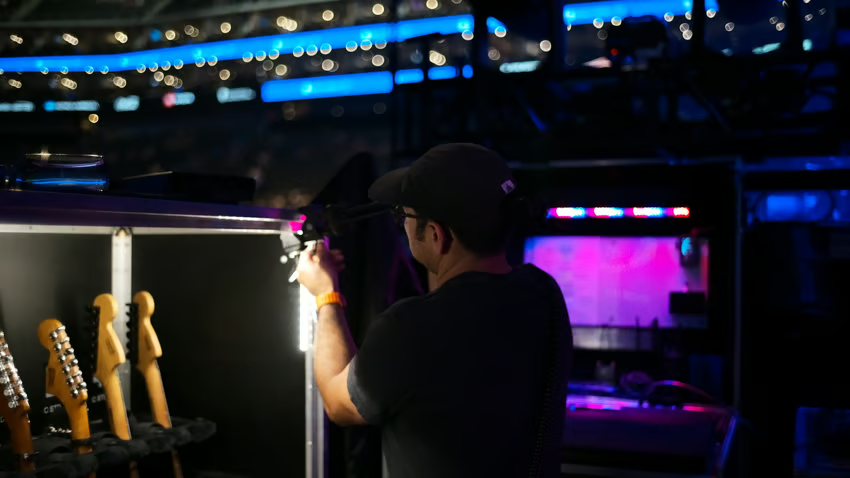
Blink 182's Missionary Impossible tour played across North America this year, with a bespoke comms package from Clair Global.
The tour ended in Las Vegas as part of the 'When We Were Young' festival following headline arena and amphitheater shows. Comms Engineer Andrew Hua supported the busy production team, managing pivotal communications throughout its duration.
"This production has some big components that require synchronicity between all departments, which is where comms becomes a vital part of tour safety," he begins.
"Our Production Manager Jimi Storey is very hands-on with all the different elements such as moving set pieces. He's constantly talking to different departments; carps, automation, lighting, video and pyro, who work together to make these moves as seamless as possible."
Hua worked with the Riedel Communications 1024 Artist Frame, a scalable digital intercom network, for the first time: "Getting acquainted with Reidel's Artist-1024 node was a technical highlight of the whole tour for me, it's an expansion to their Artist intercom and worked wonderfully."
He continues: "While the system gave me much more power than I needed, I'm glad I had it; it allowed me to configure the system however I wanted without ever feeling constricted. We also had plenty of AES67 ports."
Clair Global Operations Coordinator, Cliff Skinner, who also worked across the tour’s audio reinforcement needs, helped to build a comms system with multiple networking capabilities.
"It was great to have good flexibility throughout the rig so that I had a place to plug in transceivers almost anywhere, in any venue, without having to run tons of cable,” adds Hua. “We also used a Dante card with a Focusrite Rednet Dante to analog converter to take care of program feeds, mixes for the lighting designer, video directors and talkbacks."
Hua noted that headline shows do help with a level of controlled environment for comms engineers.
"Our shows are tailored to us, whereas festivals can bring added stress and call for extra due diligence. There's the chance that the house production or other artists will have their own comms systems within the same range, which can pose interference challenges. Asking questions early on always helps as needs often change at a festival - whether it's creating new point to points/partylines, adding new users, or integrating into another comms system. Having a dedicated comms engineer to assist or troubleshoot is key.
“My role is vital to maintaining a reliable system, and comms has become a more complex discipline over the years. The days of 2-channel comms packs are behind us as productions rely heavily on inter-departmental streams of communication," notes Hua, who has seen that evolution during his switch from monitor tech to comms engineer following years of touring within audio teams.
"Comms is interesting because you interact with every department and I’ve gained so much appreciation for what every department does to make a show like this work. I’ve also felt fortunate to have such a great team from Clair Global helping us out on Blink 182’s tours over the past few years. There was never a moment I didn't feel their support, whether it was [Account Execs] Josh Swart, Jordan Kolenc, or Cliff Skinner, they are always available and willing to help.”
More News


.png)
Support USITT
For many 501(c)3 nonprofit organizations, USITT included, donations are a lifeline. We are able to continue to expand our online offerings to our Members and to our industry thanks to Membership dollars and the generosity of our donors.