
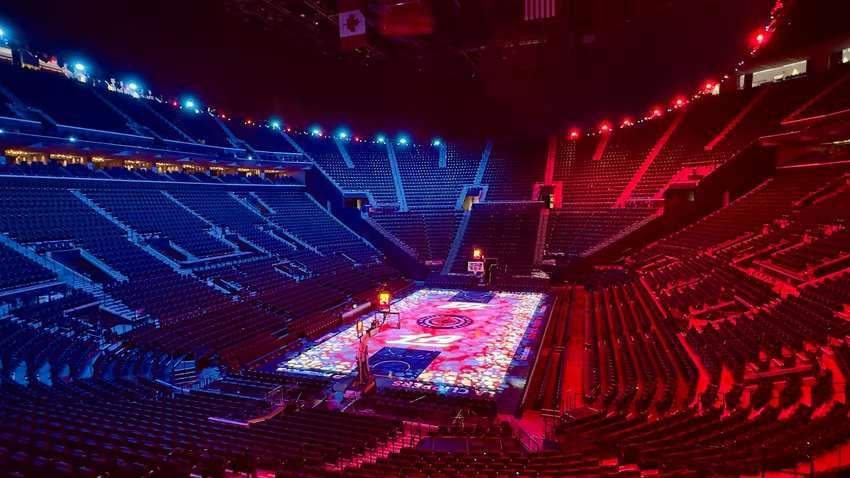
From historic arenas to next generation builds, lighting in North American sports venues is undergoing a quiet but significant shift. Recent upgrades at some of the country’s most prestigious arenas—Intuit Dome, Crypto.com Arena, American Airlines Center, and United Center—highlight a broader trend: venues are rethinking not just how they illuminate the game, but how lighting shapes the entire live experience.
Increasingly at the center of these modernization efforts is Elation, a lighting manufacturer that has steadily built momentum in the arena sector by aligning its technology with the evolving demands of live sports presentation and broadcast, while maintaining the flexibility to support a wide range of arena events. While each installation is unique, a clear pattern has emerged: venues are not simply upgrading in-game and house lighting—they are investing in flexible, future-ready systems that entertain and elevate fan engagement, redefining what fans expect from the live sports experience.
Experience-Driven Design
For some time now, the role of lighting in arenas has grown beyond simple illumination. Today, it is evolving further into a core storytelling tool, integrating with video, audio, and architectural elements to create a cohesive, immersive, and engaging environment.
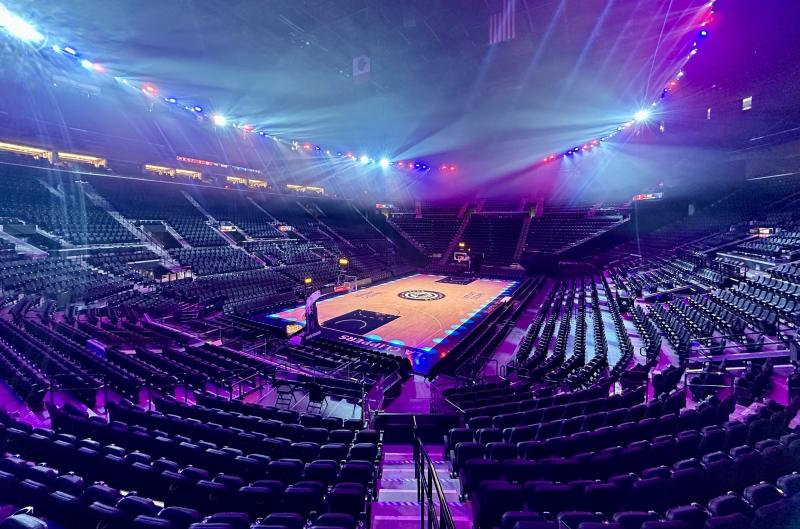
This is particularly evident at Intuit Dome, one of the most technologically advanced arenas in the world, where the lighting system, provided by sales and integration firm JRLX, Inc, was conceived as part of a wider technological ecosystem to work in harmony with video, audio, and interactive elements. Rather than relying on traditional ‘lights out’ moments, the design supports a continuous visual narrative, integrating with the venue’s circular Halo LED scoreboard and seat-based fan-engagement features for a more captivating, theatrical experience.
When the Los Angeles Clippers took the court after the upgrade, fans were treated to more than just basketball. A new Elation lighting system, featuring beam, color, and texture effects from Proteus, Pulse and Fuze fixtures, transformed the arena into a fully immersive, multi-sensory environment, driven by the vision of Clippers lighting designer Robert Sanders.
“We’ve built a system that can deliver energy and emotion every night,” Sanders said. “We take you on a journey and give you an immersive light show experience so fans don’t just watch a Clippers game; they’re part of the experience.”
The effect is less about isolated cues and more about sustained atmosphere that keeps fans engaged from the moment they enter the arena until they exit.
Team Branding
A similar philosophy underpins upgrades at Crypto.com Arena, home to the LA Kings, Los Angeles Lakers, and LA Sparks, where lighting plays a key role in reinforcing team identity and energizing the building during pivotal moments.
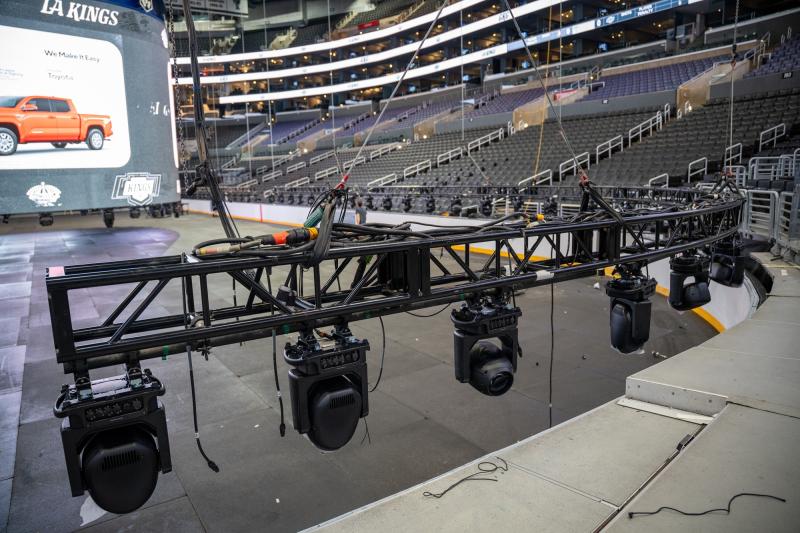
For LA Kings games, high-intensity Proteus Radius beam fixtures, mounted in a circle around the rink, create a striking cage-like effect around the ice during player intros, goal celebrations, and key game moments. This signature look, unique to the Kings, along with the broader lighting design, has become an essential element in reinforcing the team’s brand identity throughout a game.
Performance That Cuts Through
One of the biggest challenges in arena lighting is scale. Fixtures must deliver enough intensity to register clearly in a bright sports lighting environment while still delivering saturated color and crisp effects that look good both in-house and on camera.
Lighting systems installed at the United Center and American Airlines Center, for example, prioritize brightness, as well as consistency, ensuring even coverage across large playing surfaces and eliminating the hotspots or falloff associated with older technologies. This ability to “cut through” at long throws is critical in today’s arena environment, where lighting must function alongside LED scoreboards, ribbon displays, and high-definition broadcast workflows.
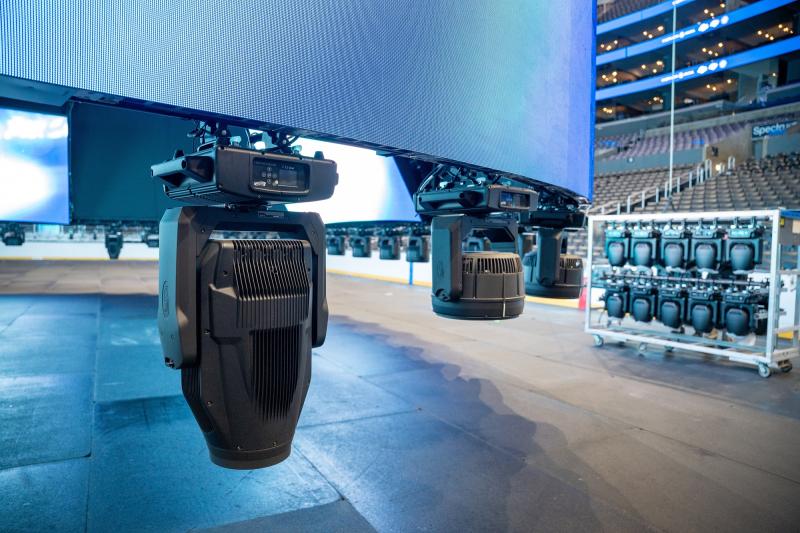
American Airlines Center, home to the NHL’s Dallas Stars and NBA’s Dallas Mavericks, replaced its aging discharge lights with Elation Paragon LED profile moving heads. “The new Pragons deliver a more even output from center to edge and are thousands of lumens brighter than most competitors in this class,” stated Robin Crouch of integration company Gemini Light, Sound & Video. “Not only are we saving them money by switching to LED, but we’re also giving them higher-quality light and more intensity—a win, win, win.”
At the United Center, home to the NBA’s Chicago Bulls and NHL’s Chicago Blackhawks, high-power Proteus Brutus LED Wash FX fixtures—part of a lighting system also provided by JRLX—deliver the ability to texture the ice or basketball court with widespread gobo coverage while maintaining strong output, even in color, for special effects. “At the almost 300’ throw distances, the units can punch through the sports lighting for broadcast,” Jason Reberski of integration firm JRLX confirms.
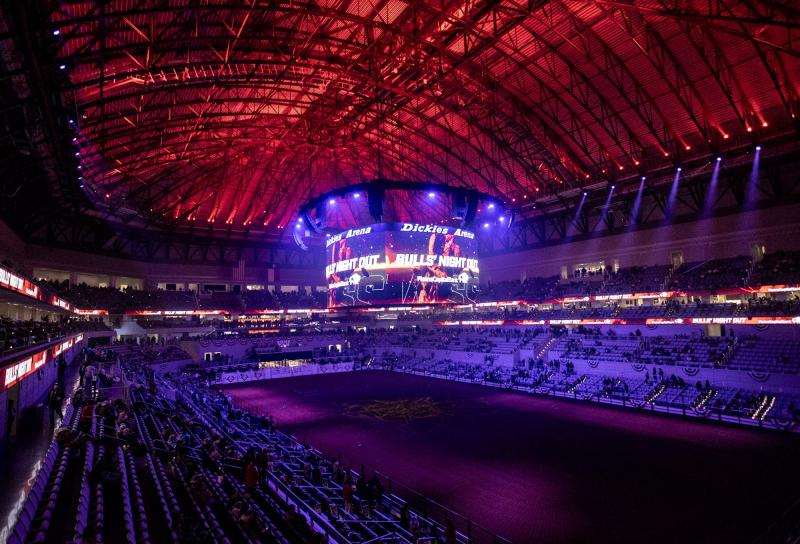
Robert Sanders, who worked closely with JRLX on the Intuit Dome project, conducted shootouts with the court lights on so he could see what looks good with deep colors, textures, and patterns. “Seeing those saturated beams carry across the arena and register on camera was incredible,” he said.
Equally important is control. The ability to shape light precisely, whether to frame a basketball court, isolate a player introduction, or avoid spill into spectator areas, has become a standard expectation. This reflects a broader move toward lighting rigs that behave more like theatrical systems, even within the scale of an arena.
Broadcast-Ready by Design
With the continued growth of live sports broadcasting and streaming, lighting systems must meet stringent camera requirements. High output alone is not sufficient; accurate color rendering, consistency, and flicker-free performance are all essential for delivering a polished on-screen product.
Across the recent sports venue installs, broadcast quality was a key consideration. Whether illuminating player introductions, highlighting key moments, supporting performances, or lighting post-game interviews, the lighting systems are designed to look as good on camera as they do in person.
At the United Center and American Airlines Center, improvements in color quality and beam consistency have enhanced both live and televised experiences. Another advantage of the Paragon fixtures at American Airlines Center, for example, is their ability to adapt—rather than being limited to a single CRI or color temperature, they can adjust to suit any situation.
At Intuit Dome, LD Robert Sanders can easily tune the lighting to broadcast standard. “Because we do a lot of presentation-style lighting, I need to illuminate the court like a stage and ensure it looks great on camera. Skin tones, makeup, costumes, outfits—everything has to look perfect for broadcast. With the Elation fixtures’ high CRI and excellent color mixing, I can achieve the ideal color temperature right from the front of the light.”
Meanwhile, Crypto.com Arena’s system includes custom solutions to reduce glare while maintaining performance, another example of the level of detail now required in modern arena design.
Reliability and Reduced Maintenance
While creative capability is critical, practical considerations are another major factor driving adoption and are often what determine long-term success. Arena lighting systems are often installed in hard-to-reach locations, from overhead catwalks to integrated scoreboard structures, where maintenance access is limited and costly.
The transition away from lamp-based sources to LED and advanced light engines has therefore become a key driver in specification decisions. Eliminating routine lamp changes reduces both labor and downtime, while also improving consistency over the lifespan of the fixture.
This was a clear factor in projects such as Crypto.com Arena, where long-term operational efficiency was prioritized alongside performance. At Intuit Dome, where fixtures mounted on the Halo LED display have limited access, reliability was a non-negotiable requirement. The installed system delivers the robustness needed for continuous, high-pressure use without frequent intervention.
IP Indoor
Ingress protection, traditionally associated with outdoor use, is also becoming more relevant indoors. In fact, these latest installations all incorporate IP-rated fixtures. Dust, debris, and the general wear of multi-event venues can impact fixture longevity, and sealed units offer a level of resilience that aligns with the realities of arena operation. This added durability translates into fewer cleaning cycles and longer operational life, particularly in today’s multi-purpose arenas that host concerts and a wide range of events year-round.
In Partnership
From early-stage demos and evaluations to final commissioning, these projects were delivered in partnership with trusted integrators and long-term collaborators, ensuring that each installation was tailored to the specific needs of the venue. Companies like JRLX, Volt Integrated, Gemini Light, Sound & Video, and others provide valuable professional advice and support, often working within tight offseason (and even in-season) windows.
Lighting’s Changing Role
Ultimately, the evolution of arena lighting reflects a broader shift toward fully integrated venue systems. Lighting must do more than illuminate; it is no longer a standalone system, but part of an interconnected infrastructure that supports fan engagement. Elation’s increasing presence in this space reflects how manufacturers are responding to these demands. As offerings continue to evolve, lighting is taking on a more defined role within this ecosystem, not just supporting the experience, but actively shaping it.
About Elation
At Elation, we collaborate with leading professionals in the lighting industry to help bring extraordinary experiences to life. As a designer and manufacturer of a wide range of high-performance entertainment lighting products, we’re proud to be a trusted partner to top lighting professionals and production/rental houses around the world. Our commitment to quality, innovation, and creative solutions has made us a go-to resource in the industry. We also offer an advanced line of lighting control products through Obsidian Control Systems, and a full range of dependable specialty effects called Magmatic. Elation serves clients worldwide through offices in Los Angeles, Mexico City, Canada, and the Netherlands. We invite you to take a closer look at elationlighting.com
More News
_0.avif)
_0.avif)
Support USITT
For many 501(c)3 nonprofit organizations, USITT included, donations are a lifeline. We are able to continue to expand our online offerings to our Members and to our industry thanks to Membership dollars and the generosity of our donors.