
%20-%20Credit%20Johan%20Persson.avif)
One of the latest additions to London’s glamourous West End, Paddington: The Musical set out to deliver a richly immersive theatrical experience, bringing the beloved character’s world to life through detailed scenic environments and visual storytelling. However, achieving this within a historic London theatre presented significant challenges.
RELATED:
- From Darkest Peru To London: Ash J Woodward Builds A Home For Paddington
- Paddington The Musical: Ash J Woodward Initial Designs
The production required full scenic video coverage across multiple architectural surfaces, including moving and flown set pieces while ensuring that projection technology remained completely invisible to the audience. Any seen equipment, audible noise, or compromised sightlines would immediately break immersion and detract from the live performance.
At the same time, the system had to withstand the stringent realities of live theatre: tight rehearsal schedules, overnight maintenance windows, and the expectation of flawless performance in each and every show.

A collaborative solution
Working hand-in-hand with Dan Trenchard (video supervisor) and Ash J Woodward (video design & animation) Panasonic projectors were selected to deliver the required brightness, colour fidelity, and reliability without compromising the aesthetic integrity of the space.
A combination of Panasonic RQ35 and RQ25 series projectors was integrated into the venue, supplied by Stage Sound Services. The selected solution balanced high-output performance with compact form factors and quiet operation, enabling projectors to be positioned front-of-house and above the audience without drawing attention to themselves. The projectors were complimented by a dedicated LED display, a rare hybrid approach that required precise planning and tuning.
The result was a projection system capable of delivering large-scale scenic imagery that blended seamlessly into the physical set, supporting the narrative rather than competing with it.
“We strive for absolute perfection, and that’s what keeps us on our toes,” explained Dan Trenchard, Video Supervisor for Paddington: The Musical. “So, there is no concern about investing in Panasonic for a show like this – the reliability speaks for itself.”

Bringing Paddington to life onstage
Ash J Woodward envisioned projection that would enhance the unique production style, in which video was treated from the beginning as a core storytelling tool rather than a mere decorative layer. “Video, for me, is always in service of the story,” he explained. “It needs to have narrative importance, but also the capacity to open up the world of the production when scale and spectacle are required.” Projection was designed to integrate seamlessly with the physical scenery, enhancing everything from bookshelves and architectural details to museum-inspired environments, without ever resembling a traditional video surface.
Trenchard played a key role in translating this vision into a practical, reliable system. “We want the video content to be the brightest, best-looking we’ve ever had — but it must never look like video,” he said. “And when the projection is not in use, we don’t want anybody to know there’s projection in the show; a lot of that comes from hiding the actual units themselves.”
This philosophy shaped every technical decision, from projector placement to content design, ensuring that projected imagery behaved more like light and texture than a conventional screen. In fact, the lighting team was so impressed by the quality of the projectors that they built the projectors directly into the show’s lighting schemes, which is historically a rare and bold production move and shows the unique power and range of the units.
Why projection — and why Panasonic
While LED technology was located at the back of the set, projection was used at scale to extend and reshape the world of the production. Large-scale projection enabled complete stage transformations, including moments where imagery wrapped around the architecture of the set and reached into the theatre auditorium itself, while also allowing for subtlety in how the set was lit and revealed. Rather than acting as a substitute for physical scenery, projection was designed to sit in conversation with it, enhancing texture, depth and atmosphere while allowing the set to remain present and tangible. “We’re not there to replace the set,” says Trenchard. “We’re there to enhance it and move it through the narrative.”
Panasonic projectors were specified early in the process, driven by long-term familiarity among the production team, confidence in performance, and a proven track record in demanding theatrical environments.
“We went straight to Panasonic on this one,” Trenchard notes. “Once those projectors are installed, they need to stay there — and they need to work.”
The creative teams were particularly pleased with the Panasonic’s emphasis on reducing projector noise in its latest generations, commenting that this is one of the most important factors of the experience and that they are eager to see what Panasonic has in store in its next generations for even further reducing the noise factor.

Engineering immersion inside a historic theatre
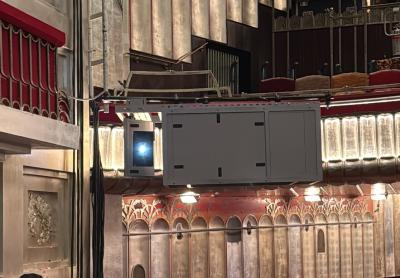
Installing high-brightness projection in a Victorian-era theatre introduced additional constraints around space, weight, and noise. Projectors had to be carefully positioned at front-of-house, in and around the audience, requiring careful consideration of sightlines and acoustic impact.
Custom acoustic enclosures helped minimize distraction from the units, with projector housings colour-matched to the venue to blend in with the historic architecture. In some locations, projectors were integrated among lighting fixtures to further reduce visual impact. “People want the projectors,” Trenchard says, “but they never want to hear them.”
This meant strategic decisions had to be made to balance absolute silence with unobstructed views, ensuring the best possible experience for the audience in premium seating areas.
“I think we’re very lucky on Paddington to have several musical numbers that are completely dedicated to video, which is not always the case. There are some numbers in Paddington which are a single principal on stage and complete projection coverage over the entire set. So, it’s sort of unapologetically video, which is really nice.”

Built for live performance, night after night
Live theatre leaves no margin for technical failure. Rehearsal schedules are tightly packed, and any major maintenance must be carried out overnight. For the Paddington production team, reliability was absolutely non-negotiable.
Panasonic’s stable performance, combined with a simplified signal chain using direct fibre connections via SDM slots, reduced potential points of failure, which is a particular advantage with projectors that are housed within acoustic enclosures. “By going straight into the projector, we removed so many points of failure,” Trenchard said.
The result was a system that could be trusted to perform consistently, allowing the technical team to focus on the show itself rather than troubleshooting. “For us, Panasonic simply means one less thing to worry about,” Trenchard added.
The theme of trust and reliance is one that is central to James Paul, Head of Video at Stage Sound Services, who helped deploy Panasonic technology based on extensive experience with other productions. “As soon as a project like this comes up, we already know what we’re going to use,” he said.

Audience impact and creative payoff
Several musical numbers in Paddington: The Musical are built almost entirely around video, placing projection at the forefront of the audience experience. In many cases, audiences are unaware they are watching projection at all, and they often mistake projected light for conventional stage lighting.
“People regularly say they loved the lighting as they are leaving,” says Trenchard. “And actually, the light they’re talking about is projection.”
For the creative and technical teams, the success of the production represents both a professional milestone and a validation of years of collaborative experience. In a powerful way, the critical success and audience enjoyment shows what happens when the arts marry the human touch to some of the world’s best technology.
“It’s one of the shows I’m most proud of in my career,” Trenchard said simply. “We came in and worked really hard, using everything that we’ve learned over the past ten years, to create something special for people. The fact that the audience love it, and we’ve had such wonderful reviews coming in — well, that’s icing on the cake.”
Paddington: The Musical is making waves among critics, audiences, and theatre professionals alike, and it goes to show how projection is becoming a central part of live storytelling magic. Of course, like so many of the best elements of live theatre, projection often becomes invisible to audiences (when it’s done right!) The unique mix of high-brightness performance, quiet operation, and proven reliability found in Panasonic projectors empowered the production team to create something genuinely special for audiences, night after night, and proves the power of reliable technology to elevate the human spirit.
Photo Credit: Johan Persson
More News



.avif)
Support USITT
For many 501(c)3 nonprofit organizations, USITT included, donations are a lifeline. We are able to continue to expand our online offerings to our Members and to our industry thanks to Membership dollars and the generosity of our donors.