
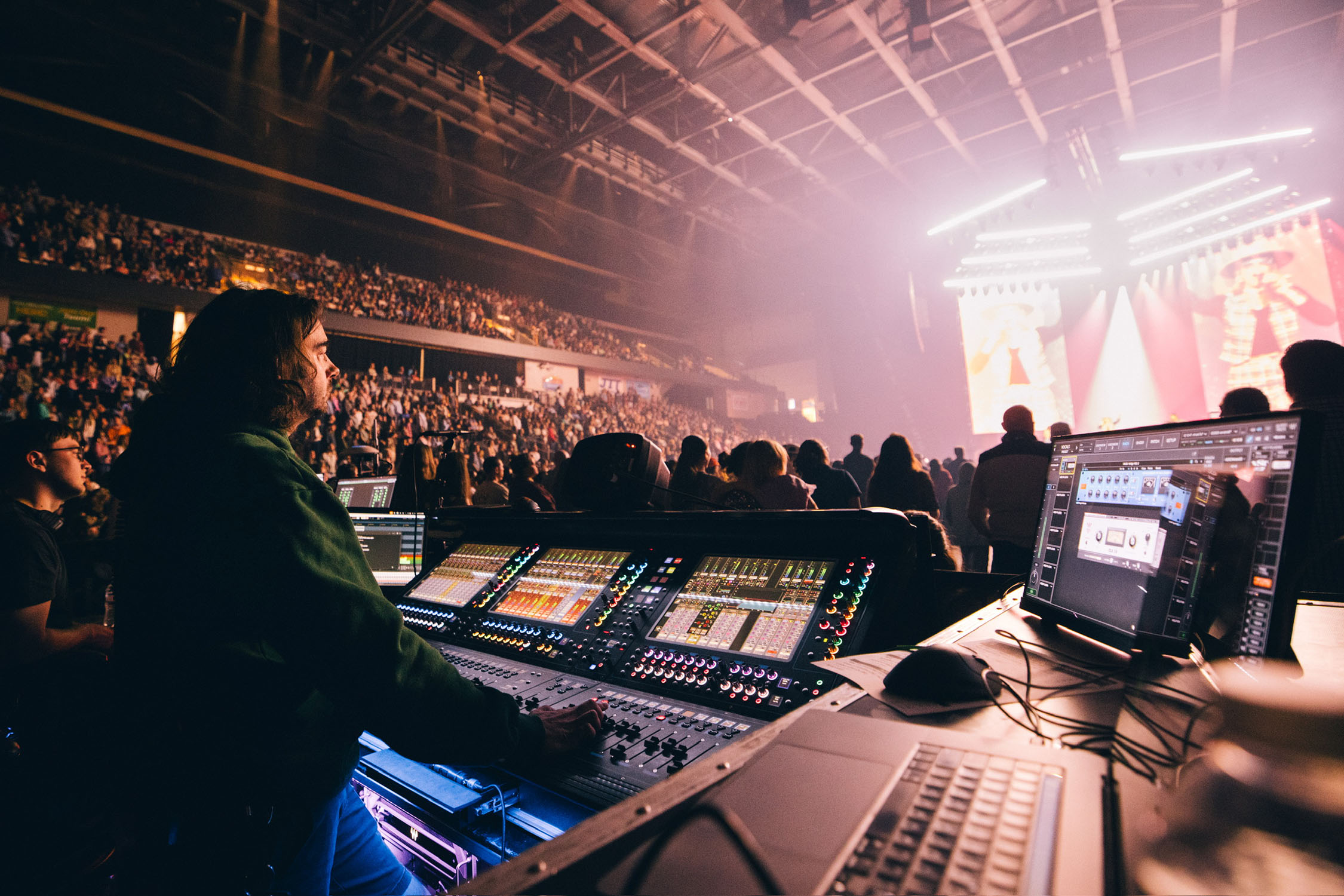
NASHVILLE, Tennessee – April 2026 – In over 20 years of recording and touring, Contemporary Christian Music (CCM) artist Phil Wickham has released fourteen worship albums, supported by numerous tours and event shows that range from churches to arenas. His 2019 Living Hope won the “Worship Recorded Song of the Year,” while Hymn of Heaven won both “Worship Recorded Song of the Year” and “Worship Album of the Year” in 2021. These and other recordings have made Wickham a staple of the CCM firmament this century.
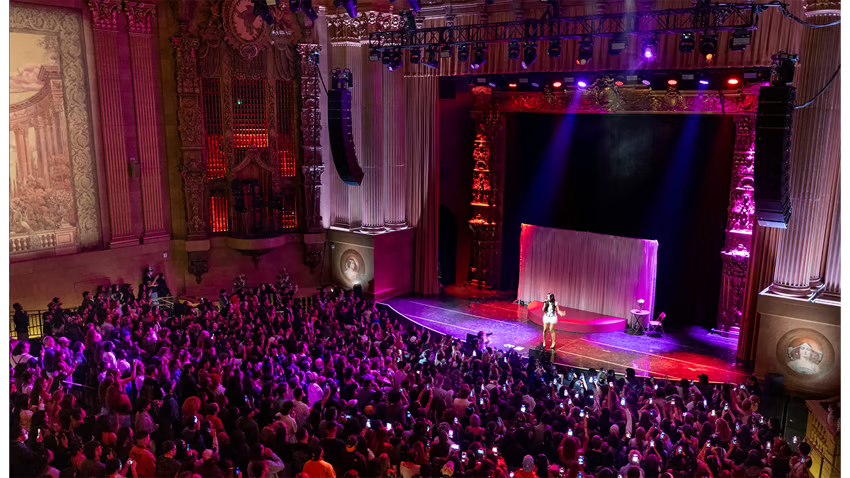
His string of live shows and tours in support of those recordings are just as successful. Keeping them that way is why Wickham’s performances have come to rely on DiGiCo consoles, including the pair of recently updated Quantum338 Pulse consoles with him on the road this year for his Songs of the Saints US spring (Mar 18 to May 24) and fall (Sep 16 to Oct 16) tour segments, along with one DiGiCo SD-Rack, one SD-MiNi Rack, and an Optocore loop network—all supplied by Nashville-based Spectrum Sound.
On the road, the consoles are being piloted by FOH helmsman Daniel Ellis and monitor maven Adam Snyder. “We’ve both used DiGiCo and Quantum extensively over the years,” says Snyder. “In fact, most of my touring experience has been on DiGiCo, and Quantum specifically the past four years. We both decided on DiGiCo for these shows after discussing options with the tour’s production manager, Boyo Manuel. Besides being a great option logistically, we have a lot of experience on them and know that they’re good and solid consoles.”
Adds Adam Snyder, “We went with the Q338 because as this tour grew I needed the higher channel count. Before the Q338 got the Pulse upgrade”—taking it from 128 to 156 channels and from 64 to 72 aux/sub groups—“I probably would’ve needed an even bigger console. But getting those extra inputs and output channels, and specifically the extra Mustard channels that the Pulse upgrade brought, allowed me to not have to make the jump to a Q5 or Q7.”
That, in turn, he says, has favorable impact on both space and logistics for shows. “We’re a full-fledged arena tour at the moment; we have eight trucks and seven buses. Regardless, everything still counts, including size and weight.”
But even when doing one-offs and fly dates between the tour’s two main legs, DiGiCo desks are waiting for them at each destination. “In those cases, we don’t always carry a package,” says Snyder. “But even then, at festivals and other events, it’s virtually always a DiGiCo. That really helps us to be able to transfer files. And some of the additional features they’ve added in the recent updates have made it even easier for us to keep more consistent when we go do a one-off. Looking at the whole year, not just a tour, we want consistency, and we like that can we get our hands on DiGiCo easily anywhere to keep the sound consistent.”
Both Ellis and Snyder have dug deeply into the Quantum tool kit and have found that they can get everything they need in terms of processing, dynamics, and EQ from the consoles themselves. Ellis has A/B-ed the equalization on both the SD and the Quantum desks and says that while both are excellent, the Mustard EQ lets him get to where he wants to go faster.
“I don’t know if it’s just my perception, but the Mustard EQ just seems to get me results quicker. So I like that a lot and I use it on drums and vocals mostly. I like the Mustard compressors, too; I use the Optical on vocals and FET Limiter a lot on drums. I’m using a Waves SuperRack Livebox to run VST3 plugins at FOH, but other than that, we’re mostly all in the console at both ends of the snake. My workflow and brain work better with less stuff, so I just try to keep it as minimalist as possible; I keep it all in the box as much as I can. In fact, I went all of last year without using anything outside of the console, just to prove to myself that I could. And it works great. I now have a few extra processors outside of the DiGiCo, but it definitely can get the job done by itself.”
Snyder immediately points to the DiGiCo Mustard Source Expander (MSE), a dynamics processor designed to reduce stage noise and feedback by lowering the level of non-transient signals (like vocals or brass) when they fall below a set threshold. Introduced in the V20 software update for Quantum consoles, it acts as a specialized gate with up to 40dB of depth, improving signal clarity.
“That's been huge for me,” says Snyder, who is also in charge of maintaining gain-sharing between the consoles and racks. “Phil used to tour with two outboard PSEs and we would always try our best to advance them for one-off gigs. Having that in the board now is awesome. I mixed a pretty gnarly sounding room in January and had that MSE across all of my vocals and it saved the show in that environment. And that software upgrade for me at monitors has been a godsend, because I am in the console—I don't have any outboard gear, and I’m not using Waves. So the more onboard tools that I can get, the better. And that one has definitely been heavily used by me and I love it.”
Like all live sound engineers, Ellis and Snyder are reluctant to make upgrades or other system changes while on the road, but they’re also still looking forward to the new ones that can integrate for the next round of shows. “I’m very excited about the latest V22 software update that just came out: integration with [Harrison Audio] LiveTrax 3, new capabilities for adding and naming markers with snapshots, and the new Mustard updates,” says Ellis. “I’m looking forward to playing with those in a couple of months. I’m just not going to be that crazy person that upgrades the console in the middle of a tour!”
Snyder takes the opportunity to talk about one element that will also be there in the future, just as it has in the past and every day today on the road: DiGiCo support. “As always, DiGiCo’s support is pretty incredible,” he says. “We haven’t had any console issues on this tour, but I know if we did, it would be a quick call to somebody and we would get an answer, and I love that. People can argue about the way a console sounds or the onboard plugins or whatever on a console, but if I can’t get support for it when it’s needed, it’s not worth it. And DiGiCo, in my experience, has always been there for me and gotten me what I needed really quickly.”
“And I’d add that our crew from Spectrum Sound has also really taken care of us. If any sort of issue has arisen, they’ve usually resolved it before we’ve had to make a call. Between our partnerships with Spectrum and Breit Group management, we feel very taken care of out on the road. That’s the way to tour: to not worry about possible issues but be able to focus completely on making everything sound great.”
For details on Phil Wickham’s upcoming Songs of the Saints US tour stops, visit www.philwickham.com. Spectrum Sound can be found online at www.spectrumsound.net.
About DiGiCoDiGiCo is a UK-based manufacturer of some of the world’s most popular, successful and groundbreaking digital mixing consoles for the live, theatre, broadcast and postproduction industries and is exclusively distributed in the US by Group One Ltd. of Farmingdale, New York. For more information, go to www.DiGiCo.biz.
Photo Credit: Colton Dall / @dallhaus_
More News

.avif)
Support USITT
For many 501(c)3 nonprofit organizations, USITT included, donations are a lifeline. We are able to continue to expand our online offerings to our Members and to our industry thanks to Membership dollars and the generosity of our donors.