
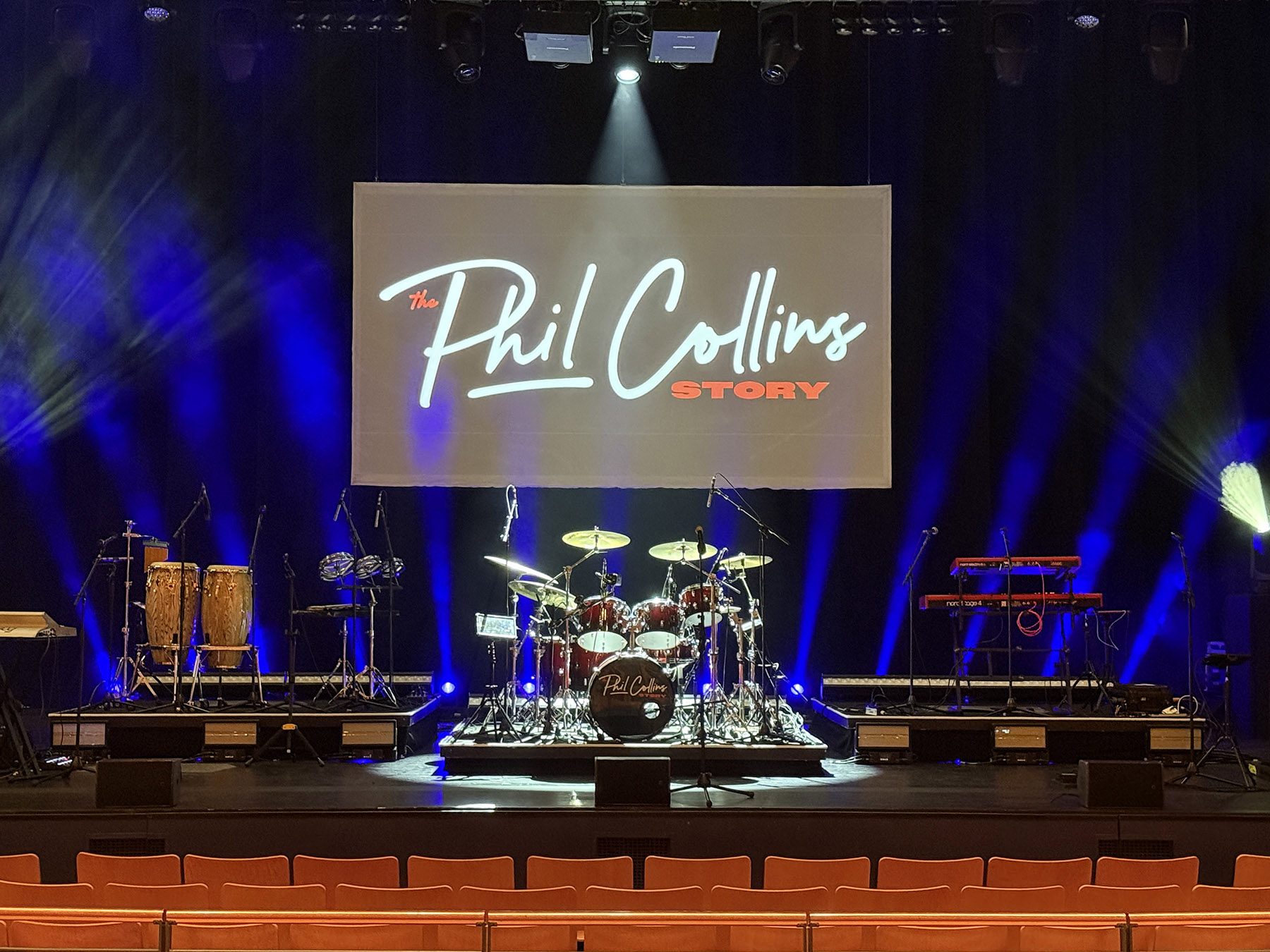
SYRACUSE, New York – July 2026 – It’s a live show. It’s a film. It’s all of the above and then some. The Phil Collins Story, a docu-concert celebrating the life, career, and music of Academy Award, Grammy, and Golden Globe-winning performer and songwriter Phil Collins, debuted February 3 at the Landmark Theatre in Syracuse, New York and then embarked on a 50-city North American tour. Chronicling Collins’ chart-topping time from Genesis to his celebrated solo career, The Phil Collins Story brings the artist’s distinctive music to life in a way that resonates with audiences visually and emotionally, featuring state-of-the-art audio, dynamic projections, and intricate lighting.
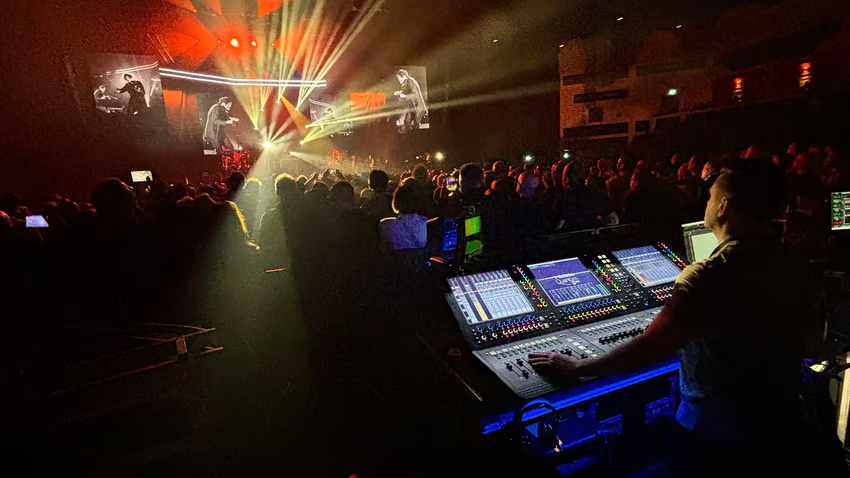
That audio for the show is delivered through a DiGiCo Quantum225 console, provided by Clair Global, managing both front-of-house and monitor duties, with the latter critically utilizing a DiGiCo DMI-KLANG card for signal distribution and control, paired with iPads running KLANG:app for the musicians on stage.
“It’s not really a film or just a concert—it’s a multimedia experience with live music,” explains Theodore “Ted” Woolsey, who did the sound design and mixes the live sound for the project, working with A2 Ethan Ginsburg-Margo. “It’s the story of Phil’s life and it goes through a lot of the stories and all the hits, including with Genesis, with live musicians onstage. It’s pretty spectacular.”
The show is true to Collins’ unique sonic signatures, including the Sennheiser 421 microphones that captured his iconic heavily-gated tom-tom fills on songs like “In the Air Tonight.” Woolsey also points out that the show is live in more ways than one: while a click track is used for the musicians, the entire production is, like much of Collins’ own career, very analog: sound, lighting, and video all operate independently of each other, relying on their respective managing engineers to keep the show together.
“The show starts with the music director running a Logic session with a click track off of his laptop next to his keyboard,” he explains. “That goes to the six musicians in the band through the KLANG:app on their iPads, and it also cues the lighting and video operators, who have their own KLANG mix as well as the click. When they hear the click, they start the show manually.”
The DiGiCo Quantum225 console is the hub for all of this, paired with some choice, authentically-vintage Phil Collins outboard gear like Bricasti reverbs and the Yamaha SPX2000 multi-effects processor, as well as some more modern Waves plugins.
“The Q225 lets me manage everything easily from a single surface,” he says. “And I designed the setup so that there’s no need for a monitor engineer—I’m using KLANG so that the musicians can mix themselves. The intuitive KLANG:app interface makes personal mixing easy for them, while the immersive mix engine helps them find the right balance much more quickly.”
“It’s really cool how I can split up audio in so many different places through so many different ‘languages,’ like through MADI, Cat5, and over fiber,” Woolsey adds. “In this case, the whole system is one Cat5 line with the DMI-KLANG card out of the console into an access point that drives all the iPads. Typically, if you were going to split up monitors, you’d have to have a split snake where you would drive all the inputs in a secondary way into another rack that goes and distributes into the in-ears. But with the DMI-KLANG, it’s all shared off a single SD-Rack, so there’s no split. It’s all digital through the one Cat5 line. That’s it, that’s the whole system—there’s no split snake rack, no networking rack. It’s just shared off the same I/O and it’s all going through this access point into the KLANG.” The simplicity of the signal path, he adds, contributes greatly to reducing the potential for any failure.
In addition, the entire show is programmed with snapshots so that during the initial rehearsals each of the musicians dialed in all of their individual mix levels per song. “Then I saved that data with the snapshots, so when I hit the next song, it changes their mix automatically to the mix that they dialed in for each song,” he says. “The combination of the Quantum and the KLANG is like having a monitor engineer that knows the whole show, but each musician is handling it themselves. And I like giving control to the musicians; they can easily make their own monitor tweaks through KLANG:app, focus on their playing, and be fully immersed in the show. And that also lets me focus on the live show and my front-of-house mix. Really, it’s the best way this show could be done.”
For more details on The Phil Collins Story, visit www.philcollinsstory.com. Clair Global can be found online at www.clairglobal.com.
About DiGiCo
DiGiCo is a UK-based manufacturer of some of the world’s most popular, successful and groundbreaking digital mixing consoles for the live, theater, broadcast and postproduction industries and is exclusively distributed in the US by Group One Ltd. of Farmingdale, New York. For more information, go to www.DiGiCo.biz.


Support USITT
For many 501(c)3 nonprofit organizations, USITT included, donations are a lifeline. We are able to continue to expand our online offerings to our Members and to our industry thanks to Membership dollars and the generosity of our donors.