
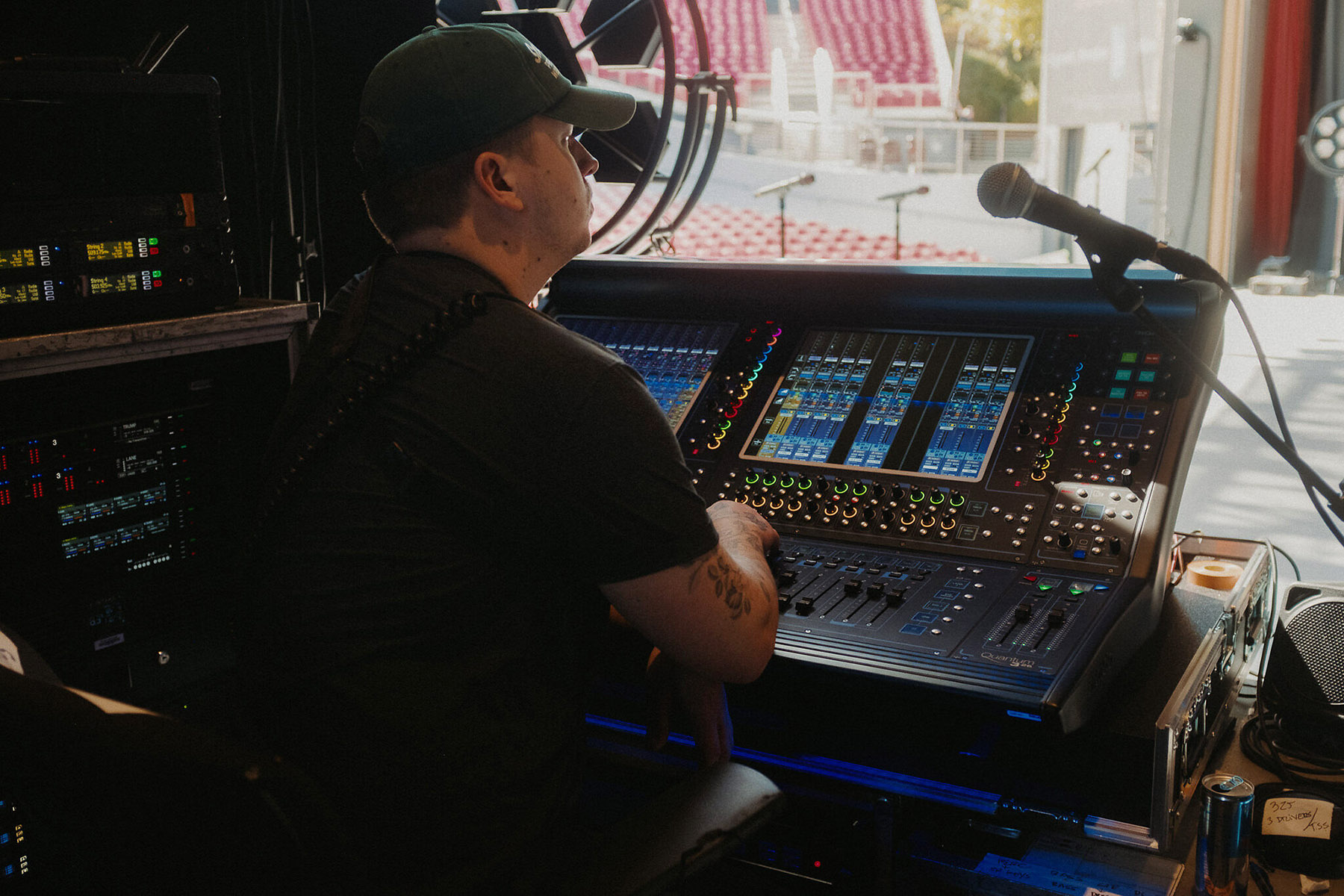
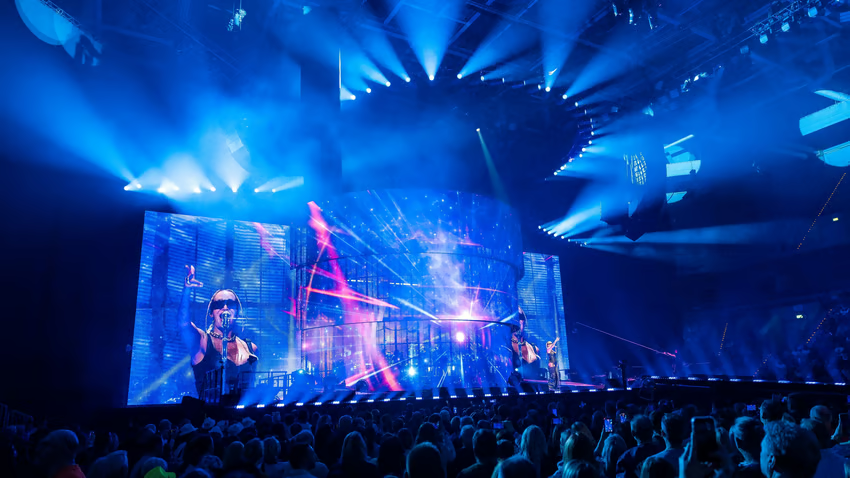
SAN DIEGO, California – May 2026 – If Thee Sacred Souls evoke Amy Winehouse’s stripped-down garage-band funk of the early 2000s, it’s not surprising: early on they shared the same scrappy Daptone Records label as the bluesy diva, as well as a similar production ethos and aesthetic, plus some key personnel. Fans won’t have to go far to hear the Souls’ soulful sound this year, because the three core band members, abetted by a dozen or so musical associates on stage, are likely coming to them: after some one-off shows this spring, including two nights at L.A.’s Greek Theatre, the trio are heading to Asia/Oceania in May, to Europe for festivals in June, on to the UK in July, and then back to North America for The Constellation Tour in August and September.
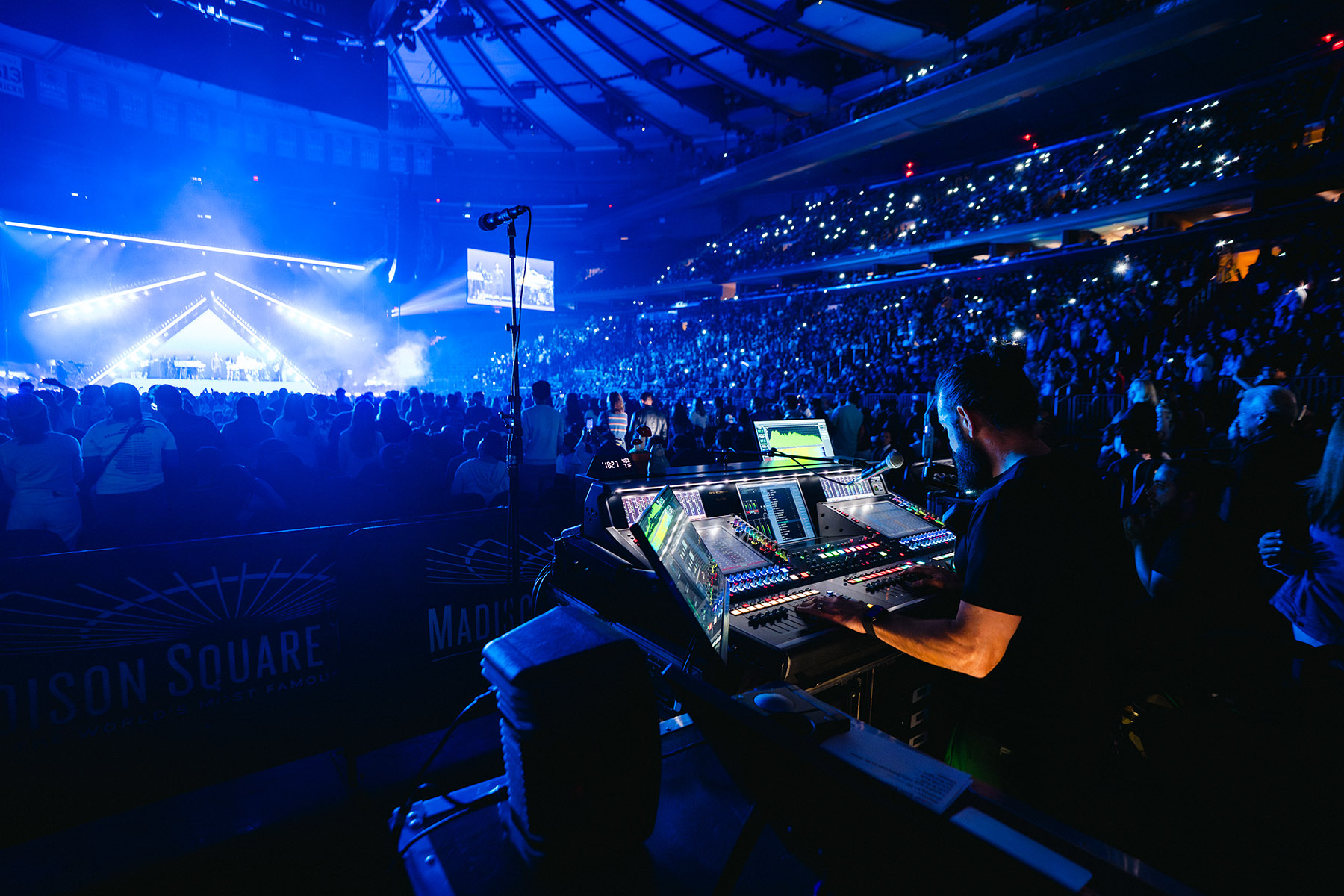
At every stop and step along the way, the shows will be passing through more than global turf—they’ll be completely within DiGiCo territory, as every show will use DiGiCo Quantum consoles. The Quantum326 will be the workhorse, its power and compact form factor the perfect choice for a diverse set of gigs and venues, and provided by the Escondido, California office of Sound Image, a Clair Global brand, with the Quantum338 and other Quantum desks ready to fill in for fly dates along the way, as well as an SD-Rack stage box.
“On our riders, DiGiCo is always the first; for our run in May, ninety percent of it will be DiGiCo,” says Josh Benton, Thee Sacred Souls’ front-of-house engineer for the last five years. “When we do our touring in the States, if we’re in a bus and have a truck, we’re always traveling with a DiGiCo. It’s been my favorite desk for that entire time.” Adds monitor mixer Zac Gerig, “Probably ten years for me!”
The band’s association with DiGiCo can be traced to a 2025 appearance on Austin City Limits. “We were on a different console for that tour; Austin City Limits was a fly-in and they had DiGiCo Quantum338 desks there,” Benton recalls. “As we’re going through sound check and line check, our lead singer, Josh Lane, gets on his mic and says ‘This is the best my mix has ever sounded. What are we doing different?’ And the monitor engineer with us at the time said, ‘Oh, we’re on this DiGiCo desk,’ and Josh looks at me and says, ‘Can we use these from now on?’ We switched and have never looked back. That’s a true story!”
While he’s used both the Quantum326 and Quantum338 on Thee Sacred Souls shows, depending upon availability and type of date, Benton says the Quantum326’s specifications and flexibility make it his favorite road companion. “Either desk is good with me, but when we get on tour, I prefer the Q326 just because it’s more compact. But we both appreciate the flexibility of the consoles. It goes without saying that they sound great, and their flexibility to let users move anything anywhere means we can each have our own workflows exactly as we want them, in any situation. I’m also a huge fan of the ability to swap out DMI cards—if we want to use different protocols on the back of the desk, it’s just swap it out and off you go. And honestly, that’s been a huge asset as of late as we started using the Dante protocol for some of that.”
Benton is a fan of Quantum’s Mustard processing, particularly its optical and other compressors, as well as some of the Spice Rack EQ features. But it’s the console’s ability to accommodate his workflow and the band’s onstage configuration that makes the Quantum326 such as great fit. “Our input list isn’t terribly big, no more than 40; they’re not playing with tracks,” he says. “If you don’t see it on stage, it’s not happening. So the processing power on the Quantum far exceeds anything I will ever use. I mean, I could have two bands on stage, double our input count, and I’d still have more than enough processing. Even with effects returns, et cetera, it’s more than enough. That really lets me concentrate on the mix and on the evolving show onstage, which can be pretty complex: as a band, it’s the three guys, but as a live act, we are at minimum an 11-piece band, and sometimes a 15-piece band if we have a string quartet with us, as we did for our two shows at the Greek Theatre in L.A. And with a single SD-Rack, we’re actually able to cover our needs and any of the support artists that tour with us, which is something we’re planning on doing for the summer run, all within one infrastructure. It makes for a very streamlined workflow.”
In monitor world, Zac Gerig also has a busy workflow, working with a combination of both IEMs and traditional wedges. “When we have strings, it’s 12 channels of stereo in-ears, and then six wedge mixes,” he says. “Monitor world is busy.”
And he’s equally effusive about his Quantum326 for that reason. “What I like is that I don’t need any outboard gear; all my processing’s done within the console itself,” he explains. “So I’m using all the built-in Spice Rack and Mustard EQs. The biggest thing, and what I like about not having any of the outboard gear, is I get to really dig into everything that Quantum has to offer.”
For instance, he calls the Mustard [primary] Source Enhancer, used to reduce microphone bleed and feedback, a “game-changer, thanks to the fact that you can sidechain the frequency input,” a capability that most PSEs can’t offer. “We have a couple of quiet singers onstage, and the MSE makes a really big difference in the bleed from the stage. Also, there’s a song where our lead singer will run through the crowd singing, and he’ll run as far as the stage design will let him. And the ability of the Mustard Source Enhancer to keep the delay and PA out of his mic is a huge advantage. In fact, we just did a show with an older DiGiCo console that didn’t have that, and it made me miss the Mustard.”
But for Gerig, it almost always comes back to workflow. “I just love the surface itself and the workflow, and the flexibility that DiGiCo provides to customize the layers and the macros,” he says. “The biggest thing for me at monitors is speed, but also the precision of sound. I try to get all of my moves down to a couple of button presses, because when we start a line check, or if we’re doing a festival and the band didn’t get a sound check, every one of the 15 people has access to a talkback that goes directly to me. And if it takes me more than 10 seconds to make these adjustments, I get buried. The Quantum’s flexibility provides the workflow that I need to keep up with 15 people on stage. If there’s an issue, I can quickly grab the right control and it’s sorted within seconds, instead of minutes, which for me is huge. On every show, there’s a lot coming at me, but I’m able to handle it all with the layout of the Quantum’s surface and its flexibility, which is why the Quantum desk has become my favorite for everything.”
For more details on Thee Sacred Souls, visit www.theesacredsouls.com. Sound Image can be found online at www.sound-image.com.
About DiGiCo
DiGiCo is a UK-based manufacturer of some of the world’s most popular, successful and groundbreaking digital mixing consoles for the live, theater, broadcast and postproduction industries and is exclusively distributed in the US by Group One Ltd. of Farmingdale, New York. For more information, go to www.DiGiCo.biz.
Photo Credit: Ben Zucker / @benzckr
More News
Support USITT
For many 501(c)3 nonprofit organizations, USITT included, donations are a lifeline. We are able to continue to expand our online offerings to our Members and to our industry thanks to Membership dollars and the generosity of our donors.