
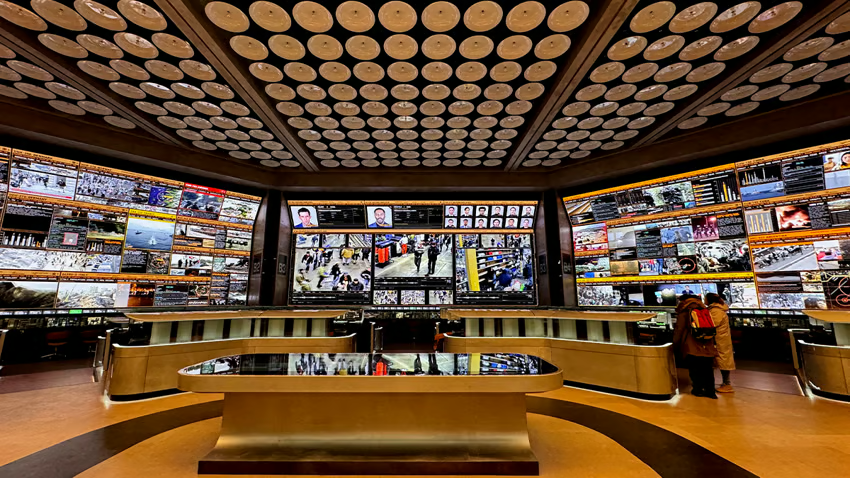
NEW YORK, NY - 4Wall Entertainment built and operated three LED and virtual production environments for Steven Spielberg's Disclosure Day, utilizing LED technology from Absen, processing from Brompton Technology, and media server and virtual production technology from Disguise. The builds were utilized across scenes including a television newsroom, covert government facilities, and high-speed car sequences as the film's characters investigate evidence of extraterrestrial contact.
4Wall led the LED and virtual production work across 3 builds; the News Room, the Wardex set, and a 360° LED car process. Each build included a Virtual Production Supervisor and Disguise programmers running real-time compositing and was tied together with image-based lighting for consistent looks across any content surrounding the actors. This setup kept playback, lighting, and image control connected during filming.
The project was led by Mathew Leland and Ben Danielowski, VPs of Special Projects at 4Wall who have led virtual production work on The Penguin, Dexter: Resurrection, Daddio, Caught Stealing, The Bride! and more. The team was brought in to help create an immersive LED environment for the film's secret agency, which utilized Disguise media servers, Brompton processing, and Absen LED tile. A core team of three worked on the project for roughly four months across pre-production, the build, in addition to a week of shooting on the Wardex set, and a week of car process. By the time the car process rolled, the crew had grown to more than ten.
Production designer Adam Stockhausen, whose credits with Spielberg include *Bridge of Spies*, *Ready Player One*, and *West Side Story,* designed the Wardex command center with LED built directly into the scenic elements. Under the supervision of the 4Wall team, the set was constructed at Steiner Studios in the Brooklyn Navy Yard and incorporated ten separate LED surfaces. Five walls wrapped the room, including side walls, angled walls, and a center wall nearly 40 feet wide and more than 13 feet tall, with five matching ceiling sections overhead. Because the screens were integrated with the scenic, the camera could shoot the full room without hiding anything that would have broken the illusion. The build used Absen PL2.5 Pro panels at 1/8th scan to help control moiré and reduce individual pixel visibility on-camera or in reflections.
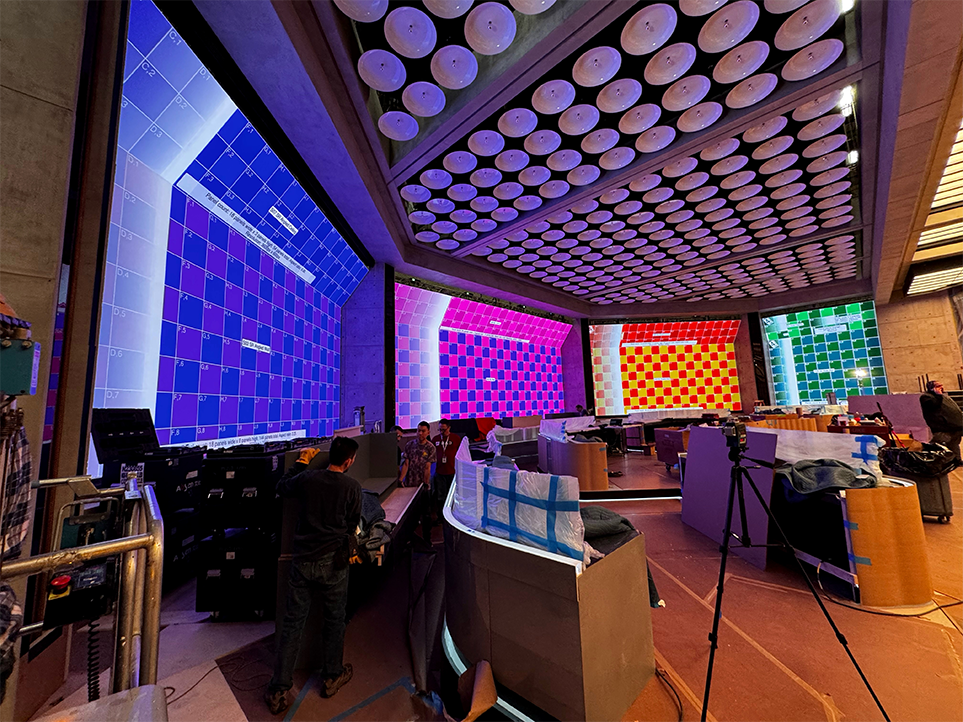
The walls formed a massive surveillance multiviewer that Wardex agents would manipulate in real time as they tracked the film's protagonists. Every action on screen was motivated by the script, so pre-rendered animation was not an option. Animation was built in the Disguise timeline, where a single section could carry 50 layers, each keyframed individually. The programmers scaled and aligned dozens of security camera feeds, GoPro footage, and other sources into the video collage seen inside Wardex. For the Disguise programmers, it was one of the most demanding shows they had worked on.
"Unlike a traditional car process or other background use of VP, the screens were the hero," said Zachary Sager, 4Wall's Director of Special Projects, Disclosure Day project manager, and Wardex set Disguise programmer. "Once we shook our usual VP reflexes, we began to treat it as a device to deliver exposition rather than simply an extension of the scenic work."
Eve Roth, 4Wall's Virtual Production Supervisor, ran point with the art department and camera teams, relaying requests to programmers Zachary Sager and Xander Taylor. The team never had fewer than two programmers on the set. One operator handled playback and changes for the current setup while the other configured light cards for the gaffer and programmed scenes ahead of the schedule, a workflow made possible by Disguise's multi-user editing. Each scene in the script was assigned a number that translated to a track in Disguise, and each beat within a scene got its own section. That structure let content be built out of sequence while other scenes were shooting. The WYSIWYG interface gave the art department the chance to approve changes ahead of time, and the team stayed ahead of the shooting schedule for the run of the set.
Spielberg's team has worked together for decades with a clear process for developing and refining each scene. The 4Wall team had to quickly understand those processes to work within the established workflow and determine which technology to use for each setup.
The News Room set used a tighter-pitch Absen PR1.9 wall as an in-camera weather screen that was important to the film's closing scenes. Instead of treating the weather image as a separate post-production layer, the screen put the image, its light, and the performers in the same room, allowing actors to interact in real time with the displayed content. The wall utilized 28 tiles at 1,792 x 1,024 pixels and was driven by a single Brompton SX40.
The car chase and crash scenes needed interactive light, a live view of the environment, and enough camera freedom to follow the action. The car process was built around those needs.
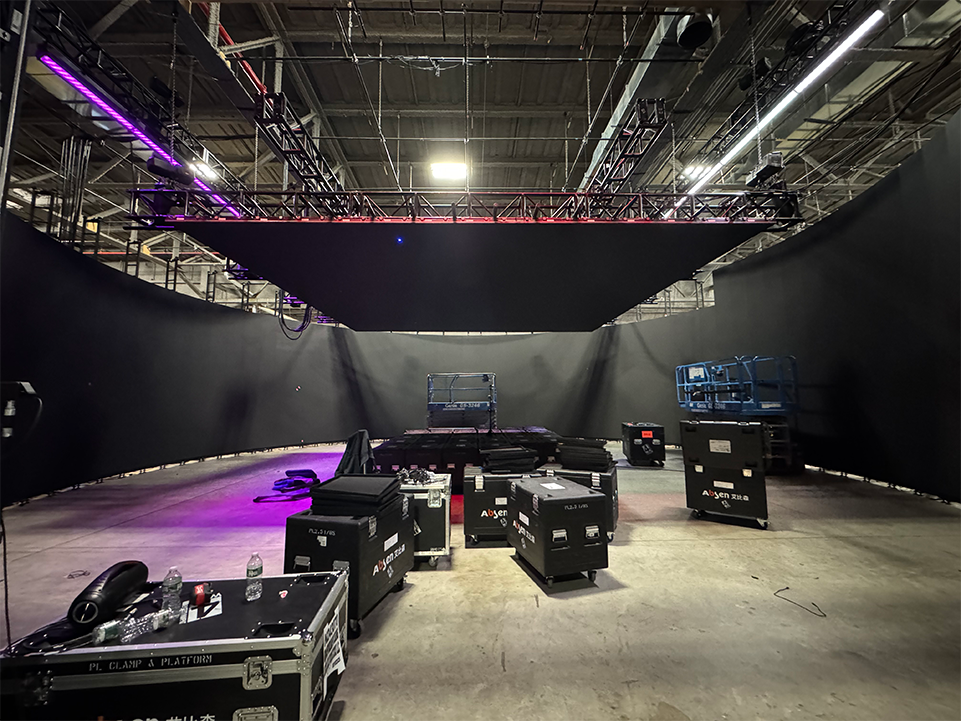
4Wall's crew built a custom 360-degree LED car process around a large Absen PL2.5 LED volume, an LED ceiling, and additional LED surfaces around the vehicle. The main volume measured approximately 132' x 16' and delivered 16,200 x 2,000 pixels. The ceiling measured 24' square and delivered 3,000 x 3,000 pixels.
Once the physical volume was built, the team ran 16K stitched spherical plates assembled from nine-camera arrays, provided by Plate Pros. Played through Disguise VX 4+ 4RU media servers, those plates could be adjusted in real time for horizon, perspective, and scale so each shot could be set for the car, lens, and camera position. One particularly demanding shot travels through the car's sunroof and ends on the protagonists' hands. That camera move would not have been possible on a moving process trailer. The LED process gave the film's production team a repeatable, controlled environment while preserving the physical behaviors needed for each scene.
Consistency across three builds came down to a single-color pipeline. Brompton Tessera SX40 4K processors were used across the project. The combination of Brompton processing and Absen panels gave the team the color range needed to replay camera footage as close to its original color space as possible. Brompton's integration with Pomfort LiveGrade then gave the DIT and DP precise color control over the walls.
Genlock technology was required for the size and scope of the three builds to keep the cameras and displays synchronized. The production shot digitally on Sony Venice 2 cameras and Brompton's ShutterSync feature matched the walls to the exact camera settings which gave filmmakers more decisions to make on set. Since the Wardex set was up for a full month, the team also used Brompton's API to report on processor health and confirm the volume was ready to shoot every day.
In terms of lighting, image-based lighting was applied across all sets. The LED screens operated in the same color space as practical light fixtures, which made the screens and fixtures work together for the same purpose. Light cards always lived on top of the screen content, with an ambient loop filling the full raster underneath the hero graphics. Disguise VX 4+ media servers handled multi-4K playout across every surface.
A consistent color pipeline across the displays, media servers, cameras, and lighting reduced the amount of traditional post-production work required for the LED-driven elements and gave the filmmakers more control over the final image on set.
The three builds gave the 4Wall team very different problems to solve. Wardex depended on live content and fast changes. The News Room required precise control of natural-looking weather footage within scenes. The car process had to support a complex camera move while keeping the production on a controlled soundstage.
"On this production, our team had the opportunity to support one of the greatest directors of our time and the amazing team he has built through the years," said Mathew Leland, VP of Special Projects at 4Wall. "Virtual production is a vast toolset, and it was incredibly rewarding to use it to help shape the narrative and expand what was possible on set."
Selected Build Details
News Room
- (1) LED surface built with Absen PR1.9 tiles
- (1) Brompton Tessera SX40
Wardex
- (10) LED surfaces built with Absen PL2.5 Pro tiles at 1/8 scan
- (10) Brompton Tessera SX40 4K processors
- (22) Brompton XD 10G-to-1G distribution units
- (4) Disguise VX 4+ media servers
Car process
- 132' x 16' main LED volume built with Absen PL2.5 Pro tiles at 1/8 scan
- 24' square LED ceiling built with Absen PL2.5 Pro tiles at 1/8 scan
- (7) Brompton Tessera SX40 4K processors
- (24) Brompton XD distribution units
- (4) Disguise VX 4+ media servers
- (4) Elgato Stream Deck XL controllers
- (10) AdderLink XDIP units
4Wall Team
- Mathew Leland, VP of Special Projects
- Piero Lamagna, Lead LED Technician - Stellular Pictures
- Ben Relf, Owner - Stellular Pictures
- Christopher Realmuto, Director of Live Events
- Will Jennings, Director of Special Projects
- Xander Taylor, Project Technology Specialist
- Eve Roth, Director of Special Projects
- Zachary Sager, Director of Special Projects
- Ben Danielowski, VP of Special Projects
About 4Wall
4Wall Entertainment is a full-service lighting, video, audio, and rigging company providing equipment rentals, production services, new and used sales, and permanent systems installations across the entertainment industry. With locations across the U.S. and U.K., 4Wall pairs a vast, meticulously maintained inventory with the technical expertise to support productions of any scale. For more information, visit www.4wall.com
About Absen
Absen Inc. is the US subsidiary of Absen, a leading LED display manufacturer, and is based in Orlando, FL. Absen is renowned for its high-quality and innovative solutions. This combination of fantastic products with a knowledgeable sales team allows us to offer turnkey solutions with outstanding client experiences. With thousands of installations across the USA, Absen Inc has quickly become an LED manufacturer of choice for a variety of prestigious projects. Highlights include sporting venues for the NBA, MLS, and NBC; casino installations for MGM Grand and Caesars Palace; premier events including the Ultra Music Festival, Comic-Con, and the Emmys; and digital signage in the heart of NYC's Times Square. For more information, visit www.usabsen.com
About Brompton
Brompton Technology's LED processing solutions power the world's most advanced visual experiences. Innovations like Dynamic Calibration and Hydra unlock the full potential of LED panels to deliver unmatched colour accuracy, uniformity and realism. Every innovation solves real customer challenges, and products are not only engineered with premium components but also designed to continue improving - delivering return on investment that lasts. Brompton's award wins include the AV Award for Manufacturer of the Year, and a Lumiere, Emmy® and King's Award for the Tessera SX40 LED processor. From live events and broadcast to corporate spaces and virtual production, Brompton is a trusted partner on the world's biggest stages - always there with expertise, training and on-site support. For more information, visit www.bromptontech.com
About Disguise
Disguise is a global technology company driving the next dimension of entertainment. One powerful ecosystem of software, hardware and services offering an end-to-end solution for visual experiences across live events, immersive experiences, stadiums, themed attractions, virtual production and broadcast. Powering experiences for the biggest entertainment companies, studios, venues and brands in the world, from Disney to Snapchat, Netflix to ESPN, the Sydney Opera House to the Burj Khalifa, and Adele to Beyonce, Disguise is everywhere - revolutionising every sector of the entertainment industry. For more information, visit www.disguise.one/en
More News
Support USITT
For many 501(c)3 nonprofit organizations, USITT included, donations are a lifeline. We are able to continue to expand our online offerings to our Members and to our industry thanks to Membership dollars and the generosity of our donors.