
American Scenic Design and Freelance Professionalism
By David Bisaha
Southern Illinois University Press, 2022, 270 pages
Paperback $40.00; eBook $25.99
Review by Tiffany Fier
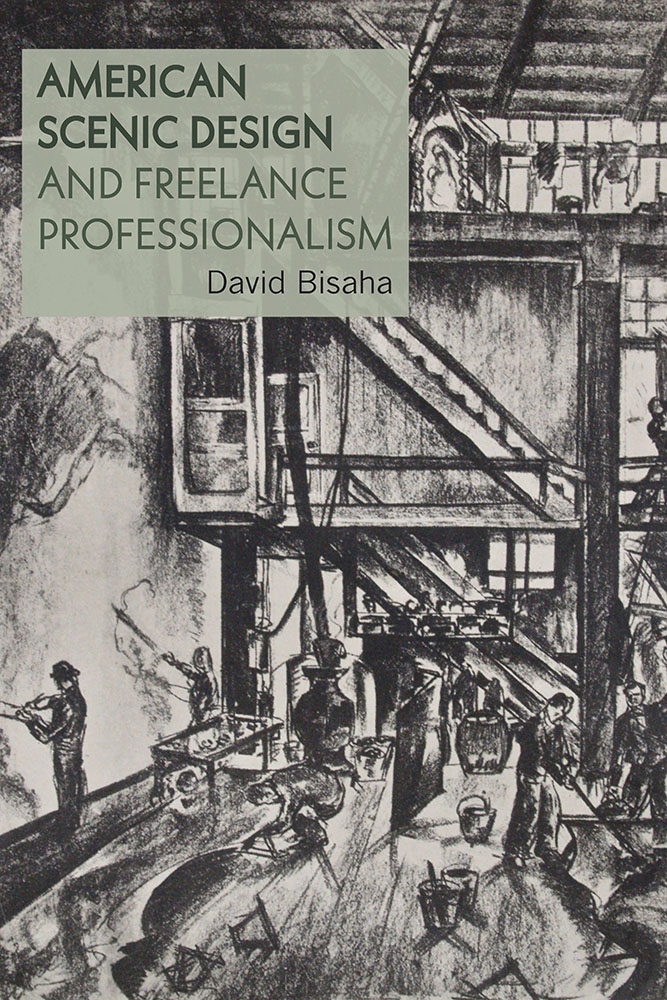
The Theatre in the Americas series from Southern Illinois University Press aims to “publish a wide range of scholarship on theatre and performance, defining theatre in its broadest terms and including subjects that encompass all of the Americas.” USITT Golden Pen Award winner, American Scenic Design and Freelance Professionalism perfectly encompasses this goal. This book traces the meticulous history of the American theatrical set designer as productions became individualized, with each production design no longer relying on standardized painted scenery.
Bishaha carefully lays out when everything started to change: the New Stagecraft Movement at Bergman Studio in 1918. Here, scenic designers established themselves as a new type of theatre creative, gradually separating themselves from the scenic artists on the paint floor. Bishaha carefully defines what he means by the word “professional” when referring to these designers, including standards of practice, ethical codes, and even what designers wore to look the part.
In the 1920s, the new wave of modernist productions demanded designs featuring abstract and expressionist-style productions. At first, United Scenic Artists of America Local 829 attempted to bring these New Stagecraft designers under their Scenic Artist umbrella. This book includes a detailed outline of everything that happened during those first decades of negotiation as set designers worked to sort out their place in the professional theatrical world, including application and examination requirements.
The book explores the rise of “celebrity designers” such as Joseph Urban and Norman Bel Geddes, as well as the emergence of university curricula for future professional designers. This section will be particularly interesting to those working in academia, as the book leads us through the early models of scenic design education at the Yale School of Drama and the Carnegie Institute of Technology in Pittsburgh.
It is also appreciated that Bisaha included those who were marginalized by this structure, specifically women and Black artists. There was a small handful of designers who managed to break into the union despite its exclusivity, including Aline Bernstein, Perry Watkins, and the first African American woman, Louise Evans Briggs-Hall. Sadly, these designers weren’t admitted by the union without the support of others, including lawyers, and often “pushed their way in by force.”
Bisaha carefully weaves in detailed explanations of professionalism theories, as well as the nuances of how union membership and governance are modified with the inclusion of new types of members. His detailed research allows the reader to feel as if they are standing in Bergman’s studio, Norman Bel Geddes's office, or learning under Donald Oenslager at the Yale School of Drama, where he developed the first set design curriculum similar to what American universities still use today.
This book is ideal for scenic designers and technicians who enjoy historical memoirs. This text is unique in its focus and is probably best for those with some general knowledge of American design history who want to dive deep into the early 20th century and see how that era shaped our current industry.
Tiffany Fier is Professor of Set Design at North Dakota State University and associate paint charge at American Players Theatre. You can reach them at tiffany.fier@ndsdu.edu.
Click here to purchase this book
More News





Support USITT
For many 501(c)3 nonprofit organizations, USITT included, donations are a lifeline. We are able to continue to expand our online offerings to our Members and to our industry thanks to Membership dollars and the generosity of our donors.