
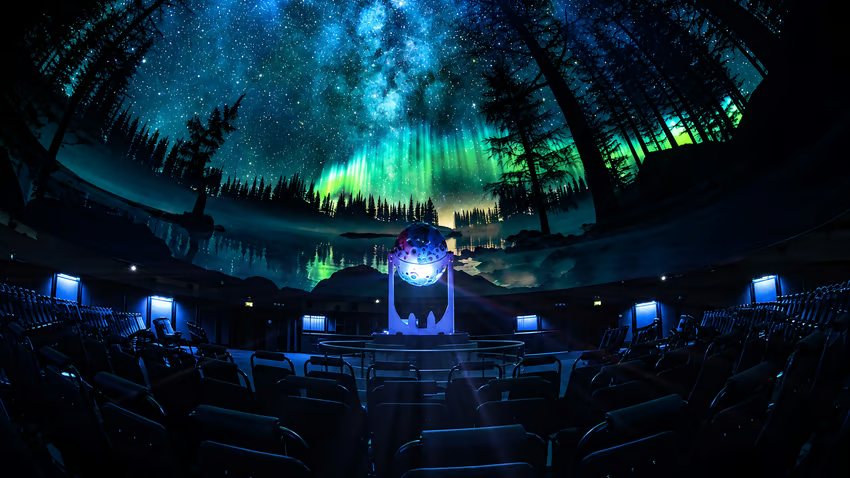
WSDG, an acoustics and AV technology consulting firm, has completed the acoustic design for the modernization of the Zeiss-Planetarium Jena ahead of its centenary. As the world’s oldest surviving large-scale planetarium, the venue presents particular challenges for modernization. Appointed by the Ernst-Abbe-Stiftung Jena, WSDG developed an acoustic strategy integrating the venue’s protected dome structure, new projection surface and HOLOPLOT immersive sound system.
The centenary modernization aimed to comprehensively improve the visual and acoustic conditions within the existing auditorium. The former inner dome was assembled from perforated metal panels whose borders, unperforated edges and imperfect joints remained visible during star shows and film projections, interrupting the intended continuous image. The replacement therefore needed to create a uniform white field for fulldome content, accommodate the concealed loudspeaker system and improve sound distribution within the auditorium’s highly curved geometry. Additionally, the cylindrical lower walls beneath the dome needed to be redesigned to optimise the sound field.
Opened on 18 July 1926, the Zeiss-Planetarium Jena traces its origins to the pioneering work of ZEISS engineer Dr Walter Bauersfeld, who developed the fundamental form of the planetarium projector in early 1919. Beginning in late July 1924, almost 80,000 visitors attended public test presentations beneath a temporary dome on the roof of the Zeiss works. The remarkable response helped prompt the development of a permanent 25-meter planetarium, designed by architects Schreiter & Schlag.
Following an earlier acoustic consultancy at Volkshaus Jena in 2021, the Ernst-Abbe-Stiftung appointed WSDG to the planetarium project in June 2025. The scope covered acoustic inventory measurements, room-acoustic analysis and modeling, assessment of the new dome-screen material, and development of the auditorium treatment concept. Prof. Dr.-Ing. Wolfgang Ahnert provided senior acoustic oversight and strategic guidance, while Tobias Behrens was responsible for acoustic consultancy throughout the project, including the existing-condition measurements, evaluation of the acoustic properties of the Endure Screens Micro Pro projection surface, and development of room-acoustic treatments for the dome and walls. Robin Breitbach supported the creation and detailing of the room-acoustic simulation model, particularly the precise modeling of the different acoustically effective materials and surfaces.
In October 2025, WSDG measured the existing auditorium before its interior was completely removed. The protected concrete cupola and internal geodesic structure remained untouched. The measurements established the room’s reverberation characteristics and identified the acoustic behavior generated by its concave dome and cylindrical lower walls.
“The architecture that makes the planetarium so extraordinary also creates a very particular acoustic challenge,” says Behrens. “In concave spaces, reflections can be directed towards focal points and sound energy can become concentrated in particular areas. Our task was to control those geometric effects while retaining a reverberation time appropriate for planetarium shows, film screenings, educational programs and live events.”
A central element of the modernization was the replacement of the former segmented inner dome lining with a visually continuous projection field. The project team selected Endure Screens Micro Pro, a surface developed for high-end projection applications. WSDG assessed its perforation and sound-transmission characteristics, confirming its suitability for use in front of the concealed HOLOPLOT X1 and X2 Matrix Arrays.
Behind the Micro Pro surface, a sound-absorptive overlay controls both reverberation time and problematic acoustic focusing. This allows the dome to function as a broadband absorptive area while maintaining the uninterrupted white surface required for fulldome projection.
“The key was to treat the dome as a single architectural, acoustic and technological system,” Behrens explains. “The screen had to deliver a seamless image, the treatment behind it had to control the room, and the loudspeakers had to remain effective through the surface. None of those requirements could be resolved in isolation.”
For the cylindrical lower walls, WSDG developed a combination of quadratic residue diffusers (QRDs), broadband absorbers and reflective surfaces. The QRD elements scatter incident sound in multiple directions, helping to disrupt the focusing patterns produced by the curved geometry. Broadband absorptive areas control reverberant energy, while strategically retained reflective surfaces prevent the room from becoming excessively damped.
Using the acoustic model, WSDG refined the placement and balance of the different treatments to promote an enveloping and evenly distributed sound field. The resulting concept was designed to support the planetarium’s wide-ranging program, including astronomical presentations, fulldome films, educational events, concerts and immersive audiovisual productions.
The acoustic work formed part of a wider technical renewal completed for the venue’s 100th anniversary. ZEISS modernized the existing UNIVERSARIUM star projector and installed eleven ZEISS VELVET 4K projectors, providing an 8K fulldome image. Together with the HOLOPLOT system, the new technology significantly expands the auditorium’s capabilities for immersive audiovisual programming.
The planetarium’s own assessment of the completed modernization is also positive. Stefan Harnisch, Technical Manager at the Zeiss-Planetarium Jena, summed up his satisfaction with a touch of understated but telling reaction, commenting: “There is a certain sense of satisfaction within me.”
“Planetariums bring architecture, image and sound together in a uniquely immersive way,” Behrens concludes. “At Jena, the aim was to respect a landmark that helped define modern planetarium design while creating the acoustic conditions required for the next generation of planetarium experiences. It is a very special project because its historic engineering and contemporary technology are inseparable.”
The modernized Zeiss-Planetarium Jena reopened in July 2026 as part of its centenary celebrations.
More News



Support USITT
For many 501(c)3 nonprofit organizations, USITT included, donations are a lifeline. We are able to continue to expand our online offerings to our Members and to our industry thanks to Membership dollars and the generosity of our donors.